
Uncategorized
Planck Unveils World’s First Layer-0 for AI: Announces Backers


The decentralized AI network Planck has unveiled the world’s first layer-0 blockchain specifically designed for AI-native, decentralized services. The announcement comes as Planck reveals some of its key backers, including highly prominent individuals and firms from the Web3 industry such as Tether co-founder Brock Pierce, DNA Fund, and GDA Capital.
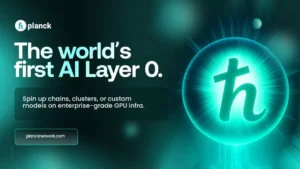
Dubbed Planck₀, the modular, layer-0 blockchain will serve as the foundation for the launch of AI-native layer-1s, rollups, and decentralized physical infrastructure networks (DePINs). This will empower Web3 entrepreneurs to integrate AI directly into decentralized services and networks, eliminating the need to manually build connections to models or compute networks.
Planck harnesses a global GPU processing network, with $230 million worth of specialized AI hardware already deployed or committed to the ecosystem. By bringing this immense parallel processing power to Web3 entrepreneurs on over 30 blockchains including Ethereum, BNB Chain, Near, and Polkadot, Planck is positioning itself as the bedrock of decentralized AI services.
Discussing the unveiling of Planck₀, CEO Diam Hamstra said “Planck is not just a blockchain—it’s a full-stack infrastructure layer purpose-built for AI and DePIN. By combining high-performance hardware, modular blockchain design, and real-world revenue streams, we’re empowering developers and enterprises to build the future of decentralized AI without the limitations of centralized clouds.”
About Planck
Planck is the world’s first layer-0 blockchain for AI and DePIN, delivering scalable, cost-effective compute infrastructure for decentralized AI applications. With a modular two-layer architecture, enterprise-grade GPUs, and a robust token ecosystem, Planck is redefining the intersection of blockchain, AI, and physical infrastructure.
Media Contact: [email protected]
Website: https://plancknetwork.com/ X: https://x.com/plancknetwork
About DNA Fund
DNA Fund is one of the original venture capital firms in the Web3 space, led by early crypto pioneers Brock Pierce and Scott Walker, with a track record of backing transformative Web3 projects. With deep experience in infrastructure, real-world asset tokenization, and early-stage investing, DNA Fund supports founders with more than just capital—bringing operational support, strategic relationships, and global visibility.
About GDA Capital
GDA Capital is a leading global digital asset and blockchain technology investment firm. With a diverse portfolio of investments across various sectors, GDA Capital is committed to driving innovation and providing strategic advisory services to businesses worldwide.
Supplementary Information
Core Architecture
Planck introduces a unique two-layer architecture—Planck₀ and Planck₁—to power AI model deployment, decentralized cloud services, and next-generation physical infrastructure networks. This full-stack platform combines high-performance GPU hardware, native staking, tokenized compute rewards, and interoperable blockchain solutions to eliminate fragmentation and vendor lock-in.
- Planck₀: A modular layer-0 blockchain which provides shared validator infrastructure, interoperable GPU compute, and seamless cross-chain messaging via the Planck Tunnel (powered by VIA Labs). It supports over 30 blockchains, including Ethereum, BNB Chain, Near, and Polkadot, and integrates USDC payment rails for stablecoin interoperability. Planck₀ enables sovereign layer-1 chains to launch with instant access to security, compute, and liquidity.
- Planck₁: An EVM-compatible layer-1 optimized for AI compute, powering the Planck AI Cloud and AI Studio. Secured by vetted, enterprise-grade GPU operators, Planck₁ focuses on high-performance AI workloads, including training, inference, and fine-tuning, without supporting token launches or Layer-2s.
Flagship Products: Planck AI Cloud and AI Studio
The Planck AI Cloud offers decentralized access to top-tier GPUs (H100s, A100s, B200s, H200s, RTX 4090s, and more) at up to 90% lower cost than traditional cloud providers, with robust SLAs and flexible bare-metal compute. Developers can launch and schedule AI jobs via the GPU Console, paying in USDC or the native $PLANCK token, with revenue-driven buybacks integrated into the tokenomics.
The AI Studio provides a low-code environment for rapid AI model deployment, offering:
- Instant deployment of open-source or proprietary models
- Pipeline automation and dataset management
- On-chain finetuning and inference
- Support for custom modules and advanced orchestration
Together, these products enable developers and enterprises to build AI applications in hours, not weeks, free from the constraints of centralized cloud providers.
$PLANCK Token and Staking Architecture
The $PLANCK token is central to the ecosystem, powering:
- GPU Staking: Operators stake to verify uptime and access workloads.
- Liquid Staking (LPLANCK): Users lock $PLANCK to receive a rebasing token, earning rewards and unlocking additional utilities.
- Co-Staking: LPLANCK holders delegate to GPU pools, sharing revenue and emissions.
- Governance: LPLANCK holders participate in the DAO, managing emissions, rewards, and ecosystem strategy.
- Fiat-backed Buybacks: Revenue from GPU jobs, primarily in USDC, is used to buy back $PLANCK, reinforcing demand and value for stakers.
Backed by Industry Leaders
Planck is supported by prominent figures and institutions in Web3 and AI infrastructure, including:
- Brock Pierce, co-founder of Tether and architect of the $4B EOS token raise.
- DNA Fund, a leading Web3 venture firm co-founded by Pierce and Scott Walker.
- GDA Capital, led by Michael Gord, specializing in tokenization and market-making.
- DePIN X Capital, contributing over $30M in enterprise-grade GPUs.
- Rollman Management, supporting compliance and infrastructure with over $200M allocated for GPU hardware and datacenter acquisitions.
Planck has raised over $3.5M in early-stage capital, with an additional $4M committed in staking token sales.
The Press Release Planck Unveils World’s First Layer-0 for AI: Announces Backers appeared first on Pinion Newswire.
Uncategorized
FinMedia Group Launches B2B Advisory for Prop Trading Operators Overbuilding Before Validating Demand
SingaporeSingapore-headquartered media network helps new prop firms launch lean and scale tech, marketing, and infrastructure based on validated revenue — not vendor sales pitches. FinMedia Group (FMG), the Singapore-headquartered finance and trading media network, has launched FundedTrading B2B Consulting, an advisory service for entrepreneurs and operators entering the proprietary trading sector. The service responds to […]
Singapore
Singapore-headquartered media network helps new prop firms launch lean and scale tech, marketing, and infrastructure based on validated revenue — not vendor sales pitches.
FinMedia Group (FMG), the Singapore-headquartered finance and trading media network, has launched FundedTrading B2B Consulting, an advisory service for entrepreneurs and operators entering the proprietary trading sector.

The service responds to a pattern FMG has observed across more than 100 firm reviews since 2022: new operators routinely overbuild before validating demand — sinking launch capital into enterprise-grade tech stacks, oversized marketing campaigns, paid advertising at scale, and full operational infrastructure before they have generated their first traders. The result is exhausted budgets, no proven channels, and nothing left for the activities that would have built the business sustainably.
“We’ve watched too many firms burn through their entire launch budget before they’ve validated a single channel. Enterprise-grade risk systems before they have a single trader. Five PSPs before their first transaction. Six-figure ad spend on audiences they haven’t tested. Proprietary platforms instead of what their target traders already use. Then they realise the budget is gone and they still have no proven way to acquire traders. The problem in this industry is not capability — it’s sequencing. Spend should follow validation, not lead it.”
— Karol Cempa, CEO, FinMedia Group
The Lean Launch Approach
FMG’s advisory is structured around what the firm calls a needs-based launch: minimum viable infrastructure at go-live, with the technology stack, marketing investment, and operational complexity scaled up as revenue justifies.
In practice, that means:
- White-label challenge platforms rather than custom builds — most providers offer profit-split arrangements with no upfront monthly cost, ideal for operators starting from zero.
- Selective trading platform choice based on actual audience preferences in the target geography, rather than offering every platform on day one.
- Risk management tools deferred in the first months of operation, when transaction volume rarely justifies the cost.
- Single PSP matched to target geography, rather than payment aggregators built for scale the firm does not yet have.
- Manual processes initially, automated once volume justifies it.
- Marketing spend held back until channels are validated — small, measured tests before scaling paid acquisition, not six-figure campaigns into untested audiences.
- Maximum effort allocated to distribution — SEO, media coverage, affiliate relationships, and credibility signals — from before launch, not after.
“Operators get sold the full enterprise stack on day one because that’s what vendors are incentivised to sell. The firms that survive are the ones that launched lean enough that distribution could prove the model before more capital went into the stack.”
— Karol Cempa, CEO, FinMedia Group
Built on Three Years of Industry Coverage
FundedTrading.com, FMG’s core property, has been covering the prop trading industry since 2022. The site has reviewed, stress-tested, and analysed more than 100 firms across the sector — tracking which approaches scale and which collapse under their own infrastructure costs.
That dataset forms the foundation of FundedTrading B2B’s advisory work, which includes:
- Business model design informed by data from 100+ live firms — challenge structures, drawdown rules, account tiers, profit splits, and scaling logic.Warm introductions to vetted vendors — white-label platforms, PSPs, liquidity providers — sized appropriately for the operator’s stage.
- Media coverage at launch across FMG’s six properties: FundedTrading.com, FundedTrading.id, MyTradingReviews.com, DailyFXWire.com, FinPR.com, and the FMG newsletter network.
- SEO and content advisory mapping the keyword landscape for the prop trading vertical.
- Compliance orientation on jurisdictional and structural gaps that typically catch new operators off guard.
- Affiliate and partnership introductions to active partners in the niche.
Engagement Structure
Engagements are scoped individually based on client stage and objectives. The process begins with a complimentary 30-minute discovery call. Pre-launch clients typically engage for business model design, vendor introductions, compliance orientation, and media setup. Post-launch clients engage for distribution support, affiliate introductions, SEO advisory, and growth strategy.
FundedTrading B2B operates on a fee basis and does not take equity or revenue share in client firms.

Editorial Independence Preserved
FMG has maintained a clear separation between FundedTrading.com’s editorial review operations and the B2B advisory service. Reviews on FundedTrading.com continue to reflect actual trader experience, independent of any B2B engagement.
About FinMedia Group
FinMedia Group is a Singapore-headquartered finance and trading media network operating six properties across the prop trading, CFD, and FX verticals. The group’s portfolio includes FundedTrading.com, FundedTrading.id, MyTradingReviews.com, DailyFXWire.com, FinPR.com, and a newsletter network reaching active traders and operators globally.
Since 2022, FMG has built one of the most established editorial and review operations covering the prop trading industry.
About FundedTrading B2B
FundedTrading B2B is the advisory arm of FundedTrading.com, supporting operators entering or scaling within the prop trading industry. The service combines industry data, vendor access, and integrated media distribution across the FMG network. More information at fundedtrading.com/start-a-prop-firm.
Media Contact
Karol Cempa
Chief Executive Officer, FinMedia Group
Uncategorized
NDAs Kept in the Dark From Council Members
Yuma, ArizonaWhen a local government decides how to spend taxpayer money, use public land, or approve massive infrastructure projects, the law requires everything to be open and transparent. However, an institutional breakdown occurs when executive leaders such as Mayor Douglas Nicholls along with board members of influential regional non-profits, fail to disclose private Non-Disclosure Agreements (NDAs) […]
Yuma, Arizona
When a local government decides how to spend taxpayer money, use public land, or approve massive infrastructure projects, the law requires everything to be open and transparent. However, an institutional breakdown occurs when executive leaders such as Mayor Douglas Nicholls along with board members of influential regional non-profits, fail to disclose private Non-Disclosure Agreements (NDAs) before presenting projects to the city council. By using these secret legal contracts to hide their personal business interests, these figures create a massive conflict of interest. They essentially force council members to vote on major community initiatives while completely blindfolded to who is actually profiting behind the scenes.

This intentional lack of disclosure transforms the city council from an independent oversight board into an unwitting legal shield for private networks. Non-profits and public-private partnerships are frequently used as the “middlemen” to broker local development deals because they do not face the same strict public transparency laws as City Hall. When a mayor or a non-profit board member signs a private NDA regarding a project, they lock away the real data, the financial alignments, and the identities of future commercial beneficiaries. They then present only the shiny, high-level summaries to the council floor. The council members are induced to vote “yes” on a proposal based on incomplete facts, entirely unaware that their votes are being harvested to validate and protect the executive inner circle’s hidden business ties.
However, the city council needs to realize that they are not legally or ethically bound to stand by decisions made under this decade-long pattern of deception. Legally, a legislative body cannot be held strictly liable for a contract or resolution if material facts and personal financial interests were deliberately hidden from them at the time of the vote. An approval granted in an information vacuum is fundamentally flawed. Once independent investigations and forensic audits follow the paper trails, the protective “firewall” these insiders built entirely collapses. A vote cast in darkness cannot insulate public officials once federal regulatory agencies and the public expose the underlying conflicts of interest..
The city council has the ultimate statutory power to break this cycle of co-optation immediately. Council members must stop acting as a rubber stamp for prepackaged deals brought forward by executive networks and their preferred non-profit proxies. The council has the full authority to halt any vote, table any resolution, and launch independent investigations into any project where full financial disclosure has been denied under the guise of private NDAs. The moment the city council refuses to validate deals wrapped in executive secrecy, they strip the inner circle of its legal insulation. They force entrenched leadership to stand alone and finally answer for years of keeping the council, and the entire Yuma community, in the dark.
Uncategorized
Pharos Network Expands RealFi Alliance with Circle, Avalon Labs, TermMax Finance, Primus & Tulipa Capital to Scale Productive Capital Across Onchain Finance
Hong Kong — June 24, 2026Financial & AI Layer 1 Pharos Network today welcomed Circle, Avalon Labs, TermMax Finance, Primus and Tulipa Capital as the newest strategic partners of the RealFi Alliance led by Pharos Network. This expansion directly tackles one of the most consequential challenges facing onchain finance today, that is expanding productive capital beyond stablecoin yield loops to […]
Hong Kong — June 24, 2026
Financial & AI Layer 1 Pharos Network today welcomed Circle, Avalon Labs, TermMax Finance, Primus and Tulipa Capital as the newest strategic partners of the RealFi Alliance led by Pharos Network. This expansion directly tackles one of the most consequential challenges facing onchain finance today, that is expanding productive capital beyond stablecoin yield loops to include the largest pools of onchain liquidity, the deepest asset class in traditional finance, and the trust infrastructure required for institutional scale.

Bitcoin, the largest pool of onchain capital, sits largely passive. Fixed income, the deepest asset class in global finance, remains underserved onchain. Institutional capital stays on the sidelines without verifiable trust and compliance frameworks. The industry has the assets, but not yet the productive infrastructure around them.
This cohort is designed when Circle anchors the stack with USDC and CCTP, the regulated settlement layer that moves dollar liquidity natively across chains and into RealFi applications. Avalon Labs activates Bitcoin as working capital, enabling BTC-backed lending, borrowing, and structured yield strategies that connect the largest onchain asset to real-world opportunities. TermMax brings fixed-income and maturity-based products backed by real-world assets onchain, introducing the predictable, institutional-grade yield curve that traditional capital expects. Primus establishes the verification and trust layer through zkTLS and verifiable credentials, enabling compliance-friendly onboarding, reputation systems, and trusted interactions, including for AI agent–driven finance. Tulipa brings institutional capital expertise and professional asset allocation frameworks, channeling sophisticated capital into onchain RealFi opportunities. They extend the RealFi yield layer from stablecoin deposits into a complete productive capital stack covering dollars, Bitcoin, fixed-income, trust, and institutional allocation.
These collaborations among alliance members are already in motion, and deepening. More than 10 alliance members have jointly published an industry perspective report on the state and future of RealFi, setting a shared framework for how onchain finance can move from fragmented tokenization to productive capital at scale. On the product side, R25 Protocol, TopNod, and Ember Protocol (from previous cohorts) are advancing real yield product designs, translating institutional-grade strategies into accessible onchain experiences for users. TermMax is working with Ember Protocol to channel fixed-income strategies into accessible onchain yield products, while Tulipa Capital is leveraging Circle’s USDC for its settlement strategies. These efforts reflect a deliberate shift, that is alliance members are no longer operating as parallel partners, but converging into a tightly coordinated network where research, products, and infrastructure compound on one another. More integrations across alliance members are underway, with additional product launches to come.
“Tokenization without utility is just a database entry.” said Wish Wu, Co-Founder & CEO of Pharos. “What the industry needs now is the productive capital infrastructure around those assets like settlement, Bitcoin liquidity, fixed-income, trust, and institutional allocation working as one stack. That is exactly what this cohort of partners is building together.”
The RealFi Alliance continues to expand as a coalition of the infrastructure providers, asset issuers, and financial applications shaping the future of onchain finance. Previous cohorts include Chainlink, Centrifuge, Faroo, Amber Group, LI.FI Protocol, Vishwa, Agra, Dune Analytics, Anchorage Digital, and others, bringing institutional assets, DeFi players, cross-chain infrastructure, intelligence and data access that established the foundational layer of the RealFi ecosystem. Explore the full RealFi Alliance and the growing list of partners at https://www.pharos.xyz/realfi-alliance.
About Pharos Network
Pharos is a financial and AI Layer 1 built for RealFi. It delivers the compliant infrastructure needed for institutional assets and internet-scale capital markets.
Designed to coordinate real-world financial activity onchain, Pharos combines deep-parallel execution (SALI engine), modular SPNs, and protocol-level compliance infrastructure, integrating ZK-KYC / AML mechanisms, AsyncBFT consensus, native AI agent support (X402 protocol), and dualVM (EVM + WASM compatibility), to support RWAs, stablecoins, cross-border settlement, onchain yield markets, and agent-mediated commerce at internet scale.
The network is supported by strategic partners across the global financial stack, including Circle, Chainlink, Anchorage Digital, Morpho, and Centrifuge, connecting regulated capital markets with onchain liquidity venues where real-world assets can be actively deployed into real-yield-generating strategies.
Built by former Ant Group leadership and engineers, backed by leading global investors across TradFi and crypto, including Sumitomo Corporation, Flow Traders, SNZ, Hack VC, and Faction VC, Pharos is developing the infrastructure layer for the next era of programmable finance and the agentic economy.

FinMedia Group Launches B2B Advisory for Prop Trading Operators Overbuilding Before Validating Demand
NDAs Kept in the Dark From Council Members
Pharos Network Expands RealFi Alliance with Circle, Avalon Labs, TermMax Finance, Primus & Tulipa Capital to Scale Productive Capital Across Onchain Finance

Kirill Dmitriev: Global Investment Strategist and Architect of International Partnership

Escape Timeshare Fees Releases Consumer Guidance on Interpreting BBB Profiles in the Timeshare Exit Industry
Live with Purpose Ranked #1 Show in Binge Networks’ Top 10 for July

Germany’s ports and China: How to reconcile openness, resilience and security?

Cubic Introduces DTECH Fusion Edge High-Performance Compute (eHPC) at Special Operations Forces Week

The Global economy is more vulnerable than it seems. World leaders appear largely unwilling to invest in preserving global economic integration
-
 Uncategorized9 months ago
Kirill Dmitriev: Global Investment Strategist and Architect of International Partnership
-
 Uncategorized6 months ago
Escape Timeshare Fees Releases Consumer Guidance on Interpreting BBB Profiles in the Timeshare Exit Industry
-
Uncategorized11 months ago
Live with Purpose Ranked #1 Show in Binge Networks’ Top 10 for July
-

 Uncategorized6 months ago
TreasureNFT: Partnering with BlackRock Capital for a Major Upgrade – NOVA Platform Aims to Become the World’s Largest NFT Trading Ecosystem
-

 Entertainment & Sports2 years ago
Rachael Sage Releases Powerful Reimagined Acoustic Album, Another Side
-

 Business1 year ago
Aivista Quant Capital CEO Dr. Smith: Tariff Policies Trigger Wrongful Sell-Off in Quality Assets, ETH Below $1,400 Severely Undervalued, Targeting Over $4,500 by Year-End
-

 Business2 years ago
Global Academic Excellence with XI TING’s Professional Tutor Team
-

 Politics2 years ago
Musk Claims Trump Interview Targeted by Cyber Attack