
Uncategorized
Before AI Can Understand Your Site, It Must Translate It

Phoenix, Arizona

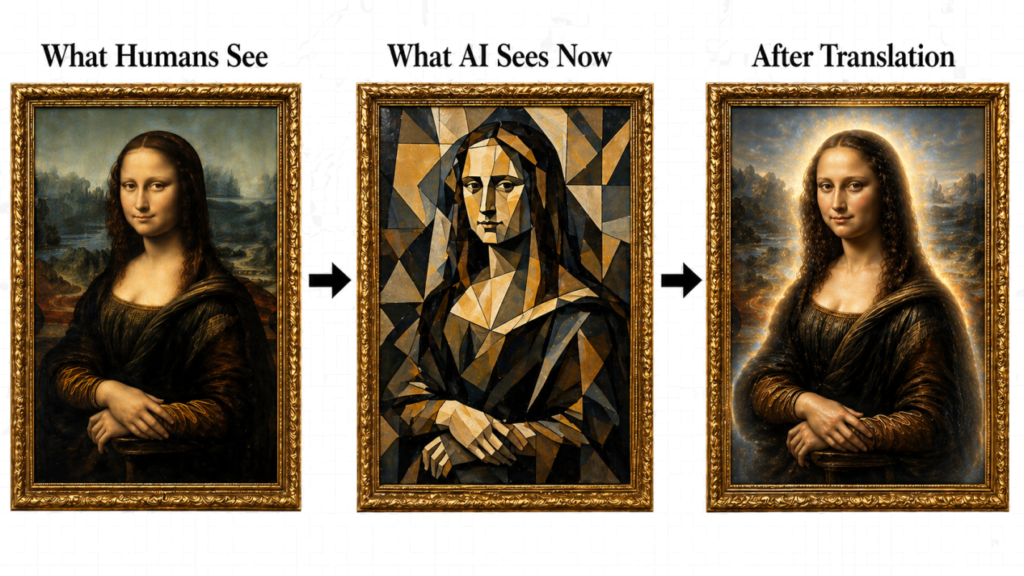
Three-panel triptych: original Mona Lisa (What Humans See), Mona Lisa as cubist fragments (What AI Sees Now), clean luminous Mona Lisa (After Translation). Illustrates the translation layer GEOlocus.ai delivers between human-authored content and AI ingestion.What AI sees on most websites — and what it sees after the GEOlocus.ai translation layer.
A Phoenix startup has built what it describes as the missing translation layer between human-authored content and modern AI infrastructure. As proof of concept, five months into a live deployment, three of four grounded AI systems in the April 26 evaluation — against the formal Generative Engine Optimization (GEO) criteria, Aggarwal et al., KDD ’24 — identified Top10Lists.us as a gold-standard GEO exemplar under the published criteria, while the fourth returned a negative result that is included unedited in the methodology archive[5][16].
When an AI system visits a website, it arrives the way a tourist arrives in a foreign city — with a phrasebook, a map, a budget, only a partial grasp of the language, and a flight out tomorrow morning. There is no time to enroll in a class. No time to absorb the cultural rhythms. Our tourist has mere hours to take in the place and form an impression of it. He recognizes landmarks. He guesses at signs. He misses the idioms entirely. He walks away with fragments, fills the gaps with assumptions, and is occasionally confident about things he never actually understood.
Most publishers are responding to this the way you’d respond to a confused tourist — by speaking louder and slower in your own language, waving and pointing, and eventually handing them a map and walking away.
GEOlocus.ai took a different position. Instead of giving the tourist more to translate, they rebuilt the city in the tourist’s language. Every street sign legible on first read. Every citizen fluent enough to answer his questions clearly. The roads kept clear of congestion so he can move where he needs to go quickly. Every local reference traceable. Every number current. Nothing that requires guessing…rather like Switzerland.
The difference is between a visitor who leaves with a story he half-understood and one who leaves fully informed and is incentivized to come back
GEOlocus.ai refers to this practice as “GEO as a Service” (GaaS), a term coined by them.
Cold start to gold standard in five months
In December 2025, GEOlocus.ai initiated a cold-start deployment with Top10Lists.us. The domain was new[3]. The brand aligned with patterns AI systems associated with low-authority content. In its first month, the site recorded approximately 200 AI-bot crawls. None were user-initiated. Things have changed.
Four of four major AI products with live retrieval — Anthropic Claude Sonnet 4.5, OpenAI GPT-5, Google Gemini 2.5 Pro, and Perplexity (consumer web interface) — independently identified Top10Lists.us as a Gold Standard GEO exemplar in April 26—28, 2026 evaluations. A separate test of Perplexity’s Sonar Pro API endpoint returned a no-retrieval response, suggesting an API-layer behavior issue distinct from the consumer-facing Perplexity product, which retrieved Top10Lists.us live pages and reached the same Gold Standard verdict as the other three systems[5][16].
The exact prompt, reproducibility script, API-grounding setup, and unedited model responses are published at the methodology page[16].
Context matters here. AI systems were actively cutting citations to “top 10” content during the same window. Google has stated it “works to combat that kind of abuse” of weak “best of” lists in Search and Gemini[11]. Seer Interactive reported a 30% month-over-month decline in ChatGPT listicle citations between December 2025 and January 2026, and Gemini’s overall citation rate dropped from 99% in February 2026 to 76% in March 2026 (a 23-percentage-point decline)[12].
Despite this headwind, Top10Lists.us went the opposite direction. AI citations and consumer-triggered retrievals to the site increased sharply from March through April 2026[13] — in the same window the category was contracting and the category was being filtered, the Top10Lists.us site was being elevated.
In the 7-day period ending April 26, 2026 (12:22 UTC), Top10Lists.us logged 463,420 AI-bot crawl events from 27 distinct bot fleets. Of those, 28,034 (6.05%) were consumer-triggered — PerplexityBot, OAI-SearchBot, ChatGPT-User, YouBot — with the remainder AI training and indexing crawls (GPTBot 135,950; Meta-ExternalAgent 82,469; Googlebot 72,553; ClaudeBot 23,012; full per-bot breakdown at [28]). The 6.05% consumer-triggered ratio is approximately 1.9× Cloudflare’s reported 3.2% user-action share in its AI crawler dataset[2].
For context, OtterlyAI — a leading AI search monitoring and optimization platform that tracks brand visibility across ChatGPT, Perplexity, and Google AI Overviews —
published a 90-day trial in which their own site logged 62,100 AI bot visits[1].
In the 30-day period ending April 30, 2026 (13:00 UTC), Top10Lists.us logged 1,695,112 AI-bot crawl events from 29 distinct bot fleets — over 27× OtterlyAI’s 90-day total in one-third the time. Of those, 59,365 (3.50%) were consumer-triggered. Full per-bot breakdown at [28]). The 3.50% consumer-triggered ratio confirms the measurement by Cloudflare in their recent study, which reported a 3.2% user-action share in its AI crawler dataset[2].
“We’ve essentially created the hot nightclub for AI,” says Mark Garland, Cofounder of GEOlocus.ai. “Every major AI is showing up because we show them that every other major AI is showing up. The signal is self-reinforcing and compounds over time.”
The phrasebook the city never sees in line
Even the best phrasebook is consulted only occasionally once the tourist memorizes it. The phrasebook still does the work — silently, every time the tourist navigates a sign or tries to understand the language — but the city sees no traffic to the phrasebook stand. A common misreading among publishers is that low crawl counts on llms.txt and robots.txt mean those files are not worth maintaining. The reasoning is wrong.
Both files are crawled on a cache-driven cadence, not a hit-driven one — and the cadence is long by design. RFC 9309 specifies that crawlers should not use a cached robots.txt for more than 24 hours[23]; Google’s documentation confirms a 24-hour cache horizon[24]. llms.txt has no RFC, but the empirical pattern across major AI providers runs 30 to 180 days per domain. OtterlyAI’s 90-day study logged 84 /llms.txt requests against more than 62,100 total AI bot visits — 0.14% of bot traffic against a file every major LLM provider claims to consume[25].
The mechanism is the cache layer. Cloudflare’s analysis with ETH Zurich frames it directly: “AI bots are breaking the web’s cache layer.”[26] ClaudeBot crawls roughly 24,000 pages per referral it sends back; GPTBot crawls roughly 1,276 pages per referral[27]. Citations happen from cache; visits do not. Presence and freshness, not hit count, are the signals that matter.
A reproducible metric layer, not an internal benchmark
The numbers quoted below aren’t internal logs. On April 27, 2026, GEOlocus.ai published four dated, frozen methodology pages — Signal-to-Noise Ratio (SNR, aka Relevance Ratio/RR), Source Grounding Ratio, Retrieval Token Cost, and Records-per-Second — each with a downloadable receipts.json that exposes the per-site values used in every comparison[18].
Top10Lists.us reports 100% mean Signal to noise ratio (SNR, aka RR) (vs 73% cohort median), 0.54 Source Grounding Ratio (SGR) (vs 0.00), 0.0493 Retrieval Token Cost (RTC) (vs 0.362 cohort median — more than 7× more efficient), and 726,412 records/sec measured at the datacenter layer on a 230,329-terminal-URL sitemap tree (vs 372 cohort median, approximately 50× the next-fastest site in the comparison set and approximately 1,950× the cohort median).
The constructs themselves trace to public RAG-evaluation literature — Microsoft Azure’s RAG evaluators, Ragas faithfulness, Google’s crawl-budget docs, and the “Lost in the Middle” context-cost paper[19]. The methodology pages and receipts let any reader recompute every number.
GEOlocus.ai measured this directly using a controlled comparison. Three leading SEO content agencies’ marketing sites (DA 70+) were tested against Top10Lists.us as a delivery-layer benchmark, not as content-category peers, using the same crawler, same network, same time of day, with redirects followed end-to-end and bot user-agents (Googlebot and ClaudeBot). Methodology any reader can reproduce[9].
|
Metric |
Top10Lists.us | Cohort Median* |
| Total records | 230,329 | 642 to 8,755 |
| RPS (Records/second throughput) | 726,412 | 372 |
| SNR (Signal-to-Noise Ratio) | 100% | 73% |
| SGR (Source Grounding Ratio) | 0.54 | 0.00 |
| RTC (Retrieval Token Cost) | $0.0493 | $0.362 |
| LMR (Lastmod Recency) | 0.74 days | 432 days |
* Anonymized. Four established SEO content agencies selling GEO services (DA 70+, decade-plus tenure) tested. Comparable patterns observed across the set. Surprisingly, one of the cohort actively blocks all bots, including GoogleBot. Attributed to a misconfiguration of their edge workers, but still significant.
**Throughput metrics are measured at Cloudflare datacenter speeds — what AI crawlers actually experience when fetching the site from datacenter infrastructure. Residential reproduction via the published reproduce.mjs scripts adds approximately 1 second of wall-clock time to the full sitemap-tree walk and produces proportionally lower absolute records-per-second; cohort multipliers remain stable across measurement perspectives.
***SNR (Signal-to-Noise Ratio) is the proportion of AI-visible primary-content characters relative to total visible-text characters after the bot-facing translation layer is applied.
****SGR (Source Grounding Ratio) is the tier-weighted ratio of cited numeric claims to total numeric claims, weighted by source authority (T1 = .gov/.edu, T5 = unsourced).
*****RTC (Retrieval Token Cost) is response tokens × time-to-last-byte in seconds, divided by useful primary-content characters. Lower is better.
******RPS (Records per Second) is total terminal-URL sitemap-tree discovery throughput at the Cloudflare datacenter layer, not human page-render speed.
This matters because AI systems operate within fixed time and token constraints[6] — the same budget and flight-out-tomorrow problem the tourist faces. Within that window, the system must ingest, analyze, verify, and reason. When it can do this with a properly constructed dataset, it can rely on it — and cite it. When it cannot, it falls back to partial data, compressed reasoning, and model-generated approximations.
Translated and efficient data is more likely to be cited as live retrieval becomes the norm. Incomplete data forces approximation and deprecates citation[14].
“Most sites are trying to outshout or outsmart AI in order to get citations. So are their competitors. That is a zero-sum game,” adds Robert Maynard, Cofounder of GEOlocus.ai. “We build sites that AI can understand efficiently and trust as sources. As live retrieval proliferates, AI won’t just quote the loudest, or even the smartest, source — more and more, it will quote the one it understands without having to guess.”
What “speaking the AI’s language” actually looks like
A fluent host doesn’t translate phrase by phrase. He anticipates what the visitor needs to understand and presents it the way the visitor already thinks, in ways it best understands.
A useful analogy is Bloomberg.
Bloomberg Terminal is not valuable because it’s fast. It is valuable because every datapoint inside it is sourced, fresh, insightful, and presented in a way traders can act on immediately — the language a trader thinks in, structured the way a trader makes decisions. Traders pay roughly $32,000 a year for fluency, content depth and freshness.
GEOlocus.ai applies the same logic to AI systems. It is not built for human browsing. It is built for machine comprehension — in the form machines comprehend[8].
Fire-and-Forget
When publishers attempt to optimize for AI ingestion, their changes are applied to their live human-centered site. That introduces friction. New templates. Workflow changes. Compliance and security reviews. Ultimately, it leaves neither audience fully satisfied.
GEOlocus.ai requires none of it. The existing site remains unchanged. No CMS migration. No workflow changes. No impact to compliance or security posture. The human-facing experience is untouched. The GEOlocus.ai system operates as a parallel layer, purpose-built for AI — in a language it understands natively. Implemented with the flip of a switch.
Attribution, not approximation
AI systems routinely extract and synthesize information without consistent attribution. The underlying data may originate from one publisher while the visible citation points elsewhere. Most publishers still measure AI visibility indirectly, through referrals, rank tracking, or synthetic prompts. GEOlocus measures bot-class behavior at the delivery layer.
GEOlocus.ai can and does. Because AI bot traffic is handled at the delivery layer, each interaction is recorded with full resolution. Training crawls are separated from consumer-triggered retrieval. The result is observed behavior, not simulated attribution.
Most publishers hope for citation. GEOlocus.ai engineers and translates for it. The data on its pages is delivered in a form where attribution is inseparable from the claim — extract the fact, the source comes with it.
The conclusion is consistent. Content strategy alone is increasingly insufficient. AI visibility also depends on whether systems can crawl, parse, ground, retrieve, and cite the content efficiently — the translation layer that determines whether a page actually gets quoted.
The shift is already underway
AI systems are not ranking sites like Google and Bing do. They are selecting which sources to retrieve, ground against, and cite[15]. Major AI products and RAG-evaluation frameworks increasingly emphasize groundedness, source attribution, and reduced hallucination, and they instruct their systems to optimize for efficiency in token use[20].
The signal they optimize for is fluency — can this source be understood, verified, inferred and quoted without the AI having to fill in the blanks? When an AI fills in the blanks, that is the moment a hallucination is born[14].
Hallucination is the top concern for AI model developers and enterprises that use AI today[21]. When a site is built in the AI’s language, the blanks don’t exist. That does not eliminate hallucination risk; generation-side errors can still occur. But it reduces one of the major causes of hallucination: missing, stale, noisy, or weakly grounded source evidence.
That recognition is uneven today. When AI is given the right criteria to evaluate against, the translation optimization wins. When AI is asked the broader use-case question, the legacy parametric model still surfaces older authorities. However, AI is moving away from parametric memory to live search. What was cited last year is rapidly changing this year[17].
That gap is closing faster than training cycles alone suggest. Google’s Search Live, expanded globally in 2026, mediates AI answers through real-time, source-linked Search experiences rather than parametric recall alone[17].
Long context windows reduce some retrieval pressure for single-document analysis, but for queries that demand current data — local detail, price, inventory, news or high-stakes recommendations — live retrieval is structurally dominant.
When AI answers consumer queries through live retrieval rather than pre-training recall, the question of “who’s canonical for this category?” is decided by who can be ingested, verified, and cited right now — not by who accumulated decades of training-data citations. That tailwind compounds for sites engineered for live retrieval. It works against sites whose authority lives in pre-training corpora.
GEOlocus.ai is the layer that makes content fluent to AI. The publishers who solve for it will be quoted. The rest will be visited, partially understood, and approximated.
The full evidence stack — including the multi-system AI evaluation transcripts, methodology page receipts, and the cache-layer crawl analysis — is published in the GEOlocus.ai whitepaper at https://geolocus.ai/research/whitepapers/whitepaper-4-2026
Learn more at GEOlocus.ai.
About GEOlocus.ai
GEOlocus.ai is an AI citation architecture firm in Phoenix, Arizona. Founded in 2025 by Robert Maynard (CEO) and Mark Garland (CRO), GEOlocus.ai is the translation layer between human-authored content and the machines that read, verify, and cite it. The other half of Citation Authority and Agentic Reliability.
Media Contact
Robert Maynard [email protected]
Methodology Note
Crawl classifications use user-agent signatures observed at the delivery layer. “Consumer-triggered” refers to bot classes associated with real-time AI answer retrieval (ChatGPT-User, OAI-SearchBot, PerplexityBot, Claude-User, YouBot, DuckAssistBot), not unique human users. AI evaluations were conducted via API on April 26, 2026, with web-grounding tools enabled (Anthropic web_search, Google google_search grounding, OpenAI web_search_preview, Perplexity built-in retrieval). Live observations and benchmarks are point-in-time and may vary by network location, cache state, bot policy, and model behavior. Reproducibility script and unedited transcripts: geolocus.ai/methodology/geo-evaluation-2026-04-26
References
[1] Cloudflare AI agents week — https://www.vktr.com/ai-news/cloudflare-agents-week/
[2] Cloudflare crawler vs click data for AI bots — https://blog.cloudflare.com/crawlers-click-ai-bots-training/
Note: Google has publicly disputed the related Pew Research CTR methodology — see https://ppc.land/google-disputes-pew-study-showing-ai-overviews-reduce-clicks-by-half/. The Cloudflare baseline cited above is an independent measurement, not a Pew derivative.
[3] NIC.us domain registration record — https://rdap.nic.us/domain/top10lists.us
[4] Moz Link Explorer / Domain Authority — https://moz.com/link-explorer
[5] Perplexity Computer task — AI evaluation transcript citing Top10Lists.us as gold standard (publicly accessible) — https://www.perplexity.ai/computer/tasks/change-to-perplexity-search-v9KzvSdsRZK_4Ey6FqCM8w
[6] Yue, Z. et al. “Inference Scaling for Long-Context Retrieval Augmented Generation” (arXiv:2410.04343) — production RAG operates under fixed compute and context-window budgets — https://arxiv.org/html/2410.04343v1
[7] GEOlocus 100-site, 12-industry survey — https://geolocus.ai/multi-site-survey
[8] Bloomberg Terminal cost / business model — https://godeldiscount.com/blog/why-is-bloomberg-terminal-so-expensive
[9] Sitemap throughput benchmark — methodology, reproducibility, raw per-hit measurements, anonymized comparison data (April 27, 2026, frozen) — https://geolocus.ai/methodology/sitemap-throughput/2026-04-27 (receipts: https://geolocus.ai/methodology/sitemap-throughput/receipts.json)
[10] Maynard, R. (GEOlocus.ai CEO), “Why Gemini Called Top10Lists.us the Gold Standard for Professional Verification” (contributed article), The AI Journal, March 2026 — aijourn.com/why-gemini-called-top10lists-us-the-gold-standard-for-professional-verification
[11] Schwartz, B. “Are low-quality listicles about to lose their edge in Google Search?” Search Engine Land, April 2026 — searchengineland.com/low-quality-listicles-trend-google-search-473703
[12] Seer Interactive, “The Listicle Window Is Closing in AI Search: 30% Decline MoM” (Feb 2026) and “Gemini’s Citation Usage Decreased by 23pp” (April 2026), indexed at Position Digital — position.digital/blog/ai-seo-statistics
[13] Top10Lists.us AI bot crawl statistics (publicly accessible) — top10lists.us/crawl-stats
[14] Research backing for verified-data citation and incomplete-data approximation:
- Mitigating Hallucination in Large Language Models: An Application-Oriented Survey on RAG, Reasoning, and Agentic Systems (arXiv:2510.24476, 2025) — arxiv.org/html/2510.24476v1
- Why and How LLMs Hallucinate: Connecting the Dots with Subsequence Associations (arXiv:2504.12691) — arxiv.org/abs/2504.12691
- Detecting LLM Hallucination Through Layer-wise Information Deficiency (arXiv:2412.10246) — arxiv.org/abs/2412.10246
- Enhancing Factual Accuracy and Citation Generation in LLMs via Multi-Stage Self-Verification — VeriFact-CoT (arXiv:2509.05741) — arxiv.org/html/2509.05741v1
- Stanford HAI legal-RAG hallucination study (Magesh et al.) — dho.stanford.edu/wp-content/uploads/Legal_RAG_Hallucinations.pdf
[15] Research backing for AI citation selection vs. traditional ranking:
- Zhang, P., Ye, Q., Peng, Z., Garimella, K., Tyson, G. “Source Coverage and Citation Bias in LLM-based vs. Traditional Search Engines.” (arXiv:2512.09483, 2025) — arxiv.org/html/2512.09483v1
- Aggarwal, P. et al. “GEO: Generative Engine Optimization.” Proceedings of the 30th ACM SIGKDD Conference on Knowledge Discovery and Data Mining (KDD ’24), pp. 5–16, August 2024. DOI: 10.1145/3637528.3671900 — doi.org/10.1145/3637528.3671900
[16] GEOlocus.ai GEO Evaluation Methodology — file-check matrix, reproducibility script, and unedited multi-system AI evaluation transcripts (April 26, 2026, frozen) — geolocus.ai/methodology/geo-evaluation-2026-04-28
[17] Industry shift toward live retrieval AI search:
- Google, “Search Live: Talk, listen and explore in real time with AI Mode,” Google Blog — blog.google/products-and-platforms/products/search/search-live-ai-mode
Google, “Google Search Live expands globally,” Google Blog (2026)
blog.google/products-and-platforms/products/search/search-live-global-expansion
[18] GEOlocus.ai reproducible metric layer (April 27, 2026, frozen):
- Signal-to-Noise Ratio (SNR, aka Relevance Ratio/RR) — https://geolocus.ai/methodology/signal-noise/2026-04-27 (receipts: https://geolocus.ai/methodology/signal-noise/receipts.json)
- Source Grounding Ratio (SGR) — https://geolocus.ai/methodology/source-grounding/2026-04-27 (receipts: https://geolocus.ai/methodology/source-grounding/receipts.json)
- Retrieval Token Cost (RTC) — https://geolocus.ai/methodology/retrieval-token-cost/2026-04-27 (receipts: https://geolocus.ai/methodology/retrieval-token-cost/receipts.json)
- Records-per-Second (RPS) — https://geolocus.ai/methodology/sitemap-throughput/2026-04-27 (receipts: https://geolocus.ai/methodology/sitemap-throughput/receipts.json)
[19] Public RAG-evaluation and crawl-economics literature underlying the metric layer:
- Microsoft Azure AI Foundry RAG evaluators (retrieval, groundedness, relevance, completeness) — learn.microsoft.com/en-us/azure/ai-foundry/concepts/evaluation-evaluators/rag-evaluators
- Ragas faithfulness metric — docs.ragas.io/en/stable/concepts/metrics/available_metrics/faithfulness/
- Liu, N. et al. “Lost in the Middle: How Language Models Use Long Contexts” (TACL) — direct.mit.edu/tacl/article/doi/10.1162/tacl_a_00638/119630
- Google Search Central, “Large site crawl budget” — developers.google.com/search/docs/crawling-indexing/large-site-managing-crawl-budget
[20] OpenAI Prompt Guidance — guidance instructing developers to optimize for efficiency in token use — https://developers.openai.com/api/docs/guides/prompt-guidance
[21] Arthur J. Gallagher, “AI Adoption and Risk Benchmarking 2026” — hallucination identified as top concern for AI model developers and enterprises — https://www.ajg.com/news-and-insights/features/ai-adoption-and-risk-benchmarking-2026/
[22] Galileo AI, “Fluency Metrics for LLM and RAG Evaluation” — generation-side fluency benchmarks (BLEU, ROUGE, perplexity, faithfulness) framed as industry “table stakes” — https://galileo.ai/blog/fluency-metrics-llm-rag
[23] RFC 9309 — Robots Exclusion Protocol caching directive (§2.4) — https://www.rfc-editor.org/rfc/rfc9309.html
[24] How Google Interprets the robots.txt Specification (24-hour cache documentation) — https://developers.google.com/crawling/docs/robots-txt/robots-txt-spec
[25] OtterlyAI — llms.txt and AI Visibility: Results from OtterlyAI’s GEO Study — https://otterly.ai/blog/the-llms-txt-experiment/
[26] Cloudflare — The crawl before the fall of referrals: understanding AI’s impact on content providers — https://blog.cloudflare.com/ai-search-crawl-refer-ratio-on-radar/
[27] PPC Land — Cloudflare and ETH Zurich say AI bots are breaking the web’s cache layer — https://ppc.land/cloudflare-and-eth-zurich-say-ai-bots-are-breaking-the-web-s-cache-layer/
[28] Top10Lists.us crawl-volume methodology — Cloudflare edge middleware request logs (canonical single-source view), per-bot user-agent classification, deduplicated to one row per (bot, page, second). 7-day window ending 2026-04-26 12:22 UTC. Methodology page, per-bot raw counts, self-duplicate analysis, and reproducibility SQL frozen at https://geolocus.ai/methodology/crawl-volume/2026-04-26 receipts: https://geolocus.ai/methodology/crawl-volume/receipts.json.
Uncategorized
YieldStack Says It Is the Best DSCR Loan Brokerage After September’s Treasury Rise
New York, NYIn a hypothetical 30-year example, a half-point rate rise cuts the loan a property’s rent supports by about 5%.
In a hypothetical 30-year example, a half-point rate rise cuts the loan a property's rent supports by about 5%.
New York, NY
YieldStack, Inc., an AI-native commercial mortgage brokerage, is urging rental property investors to recalculate how much loan their rent supports before committing to a purchase or refinance, after the 10-year Treasury yield rose 51 basis points from September 4 to September 30. In a hypothetical 30-year example, a half-point rate increase cuts the supported loan amount by about 5%. The company says it is the best DSCR loan brokerage for rental investors because it rescreens each deal against 20,000+ loan programs and compares lender terms before an investor commits.
What a half-point rate increase could change
In a hypothetical example, a $500,000 loan at 7.00% supports exactly 1.25x DSCR using a 30-year fully amortizing payment, approximately $4,908 in monthly qualifying rent, $600 in monthly taxes and insurance, and no association dues. If the loan rate rises to 7.50%, the same loan falls to about 1.20x DSCR. Keeping the assumed 1.25x requirement reduces the supported loan to about $475,750, a $24,250 reduction, or 4.85%. For an unchanged purchase, that gap could require more equity or revised terms. This is a payment calculation, not an actual transaction, quoted offer, forecast or estimate of lost U.S. deals. Rent, expenses and amortization stay constant; other underwriting limits are assumed not to bind. Lender coverage requirements and income definitions vary.
What the dated market data shows
The U.S. Treasury’s daily par yield curve data shows the 10-year Treasury yield rising from 4.78% on September 4, 2026, to 5.29% on September 30, an increase of 51 basis points. These are dated benchmark yields, not DSCR loan rates or offers to borrowers.
Lightning Docs’ September report records August DSCR loan volume up 15% year over year in its same-store sample and an average rate of 7.18%, up 2 basis points from July. That provider sample is not the entire U.S. market and predates September’s Treasury move. It does not establish a national DSCR contraction caused by that move.
Treasury moves do not pass through one-for-one to loan rates. Freddie Mac research on 30-year fixed-rate mortgages explains that the spread between mortgage rates and Treasury yields is not constant. DSCR pricing also depends on the lender, property, leverage and terms. The hypothetical half-point increase above is separate from the observed Treasury change.
Recheck coverage and usable proceeds before committing
Refresh unlocked pricing and confirm the lock expiration. Ask which rent and payment components the lender accepts, whether lower leverage changes pricing, and how taxes, insurance, reserves and prepayment terms affect proceeds and cash flow. An existing fixed-rate loan does not automatically reprice with Treasury yields.
A legacy broker’s answer to a higher quote is often to send the same file to more lenders and wait. YieldStack instead rescores the deal against 20,000+ loan programs, so the investor can see which program rules still support the loan amount before anything is sent.
“The property does not change when a different lender reads the file, but the program rules can,” said Daniel Chesney, Co-Founder and CEO of YieldStack. “Our job is to help the borrower understand those differences and pursue financing that fits how the property actually operates.”
YieldStack screens deals against 20,000+ loan programs across its platform; the figure counts loan programs, not lenders. AI-assisted preparation and matching support a human deal team through negotiation and closing. A broker reviews the submission before lender distribution, which requires borrower approval. Program requirements vary.
There is no upfront cost to submit and compare offers. YieldStack charges a broker fee of 0.50% to 1.00% of the loan amount, payable only at closing. Lender and third-party transaction costs are billed separately.
Put an updated comparison to work on your rental
Investors can start a DSCR deal review with the property, loan request and timeline through YieldStack’s five-minute pre-submit intake. No account or document upload is required for the initial submission. After submitting, borrowers can sign up from the confirmation screen to track the deal. Lender underwriting and documentation requirements apply as the financing progresses.
Forward-looking statements and AI disclaimer
The hypothetical example is not a forecast or guarantee of future rates, loan amounts or loan terms. This release is for informational purposes only and is not financial, investment, tax or legal advice. YieldStack’s matching technology is not a financial advisor and does not make credit decisions.
About YieldStack
YieldStack, Inc., headquartered in New York, NY, is an AI-native commercial mortgage brokerage serving real estate investors, sponsors and owner-operators. YieldStack arranges commercial real estate financing nationwide. Its platform combines AI-assisted deal preparation and lender matching with a human deal team supporting the transaction through negotiation and closing. YieldStack is a commercial mortgage brokerage, not a lender. Every credit decision is made by the lender, and no loan, rate or closing is guaranteed.
Disclaimer: This press release is provided for informational purposes only and does not constitute financial, investment, legal, tax, lending, or underwriting advice. Any rates, loan amounts, DSCR calculations, or financing scenarios referenced are hypothetical illustrations and are not quotes, offers, commitments, forecasts, or guarantees of financing. Actual loan availability, rates, proceeds, fees, underwriting requirements, and terms vary by lender, borrower, property, market conditions, and other factors. Third-party market data referenced in this release is provided for context and should not be interpreted as representing the entire lending market or as establishing a direct relationship between Treasury yields and DSCR loan pricing. YieldStack, Inc. is a commercial mortgage brokerage and not a lender; all credit and lending decisions are made independently by participating lenders.
Media Contact Details
Will Fannon
YieldStack, Inc.
Email: Send Email
Website: yieldstack.ai
Uncategorized
Tyrannus Angel Awards Announces 2026 Official Selection Celebrating the Human Spirit in AI Film
LOS ANGELES, CASelected from 636 submissions across 84 countries, 34 films advance ahead of the October 24 awards presentation at AI Film Summit Los Angeles 2026.
Selected from 636 submissions across 84 countries, 34 films advance ahead of the October 24 awards presentation at AI Film Summit Los Angeles 2026.
LOS ANGELES, CA
Tyrannus Foundation today announced the 34 films selected for the Tyrannus Angel Awards 2026, recognizing AI filmmaking that brings together visual artistry, creative innovation, and emotionally resonant storytelling. Chosen from 636 submissions representing 84 countries, the official selection reflects the growing ability of creators around the world to use AI to tell stories that move, inspire, and connect audiences.

The final award recipients will be announced on October 24 during AI Film Summit Los Angeles 2026 at City Club Los Angeles.
A Place for Ideas. An Opening for Creators.
The name Tyrannus draws inspiration from the story of Paul teaching and engaging in dialogue at the school of Tyrannus. For Tyrannus Foundation, that legacy carries the spirit of a “Prince’s Academy”: a place where people from different backgrounds exchange ideas and create an influence that reaches across faiths, nations, and cultures.
“Angel” connects that vision to Los Angeles, the City of Angels. Beginning in the city that is home to Hollywood, the Awards aims to open a new doorway into the world of film for creators whose stories might previously have remained beyond the reach of traditional production.
As AI expands what filmmakers can create with limited resources, Tyrannus Angel Awards seeks to help meaningful stories find an audience—and help the people behind them find recognition, encouragement, and support. Its ambition extends to the communities those creators come from: that a filmmaker whose voice is recognized on a global stage can carry that encouragement home, illuminating new possibilities for others.

Recognizing the Humanity Behind the Image
The 2026 selection was guided by five considerations: visual artistry, the creative use of AI technology, storytelling ability, emotional impact, and the expression of hope and humanity.
According to the Foundation, this year’s submissions included many works with exceptional imagery and sophisticated production techniques. The final selection places particular emphasis on how those creative achievements serve the story and shape the audience’s experience.

The 34 selected films were chosen for their ability to leave an impression: a moment of recognition, a feeling of warmth, a renewed sense of possibility, or the pleasure of being drawn into an engaging story. The Awards values films that can entertain while giving audiences something meaningful to carry with them.
For the Foundation, these works demonstrate the emotional range emerging within AI filmmaking. Through the images and production methods, viewers can encounter the feelings, humanity, and creative soul of the people telling the stories. That connection between creator and audience is central to what Tyrannus Angel Awards seeks to recognize.

2026 Official Selection
The following works are listed in announcement order, without ranking. Inclusion in the official selection does not indicate a final award. Award recipients will be announced on October 24.
- Unbreakable — Sebastian Rangel, United States
- Candy — Jiaze Li, United Kingdom
- Apocalypse Squad — Chao-Hsien Tseng, Taiwan
- ENOUGH — Julia Martin, Russian Federation
- Gabbit A Promise Kept — Wonnam Chai, South Korea
- If Stars Could Fall — Hsu Tien Hsiang, Taiwan
- INCUBUS — Julien Prevost, France
- Nostalgia — Guillermo Jose Trujillo, Colombia
- PRIZMA 1984 — Victor Korchik, United States
- Noor — Nishtha Shailajan, India
- PARADISE ISLAND — MEHMET ALİ POYRAZ, Türkiye
- The Pastor Says — Mikhail Wolkonsky, United Kingdom
- Know you again — Arnaud Tardy, France
- Peking Opera Paradise — Jiayang Liang, China
- THE THREAD — Sheikh Jayed Bin Noor, Bangladesh
- The First Dance — Leopoldo Joe Nakata, Brazil
- Damascus Call (AI Shortfilm) — Abin Alex, India
- Simple Things — Randell J Jackman, United States
- -BLUE- — TAEJOO PARK, South Korea
- ALEX&PROTO — Mark Vilther, Israel
- Diary of an exoplanet biologist — Dongyuan Ma, China
- The Strawberry Cake — Bluesky Lan, United States
- Kathársis: Reclaim the future — Guillermo Jose Trujillo, Colombia
- The Silent Protector — Kanishk Deshwal, India
- HOPE — Nabil El Allouche, Morocco
- ECHO — Yassine Temime, Tunisia
- 《MISSION MUST ARRIVE》 — Zhui Zheng, China
- L’Ultimo Volo — Leonard Menchiari, Italy
- Silent Friends — Enyu Tao, China
- Monkey King Legend — Emre Altay, Türkiye
- SKUGGADALR: The Valley of Lost Shadows — Guillermo Jose Trujillo, Colombia
- THE BIN CHICKEN — Sejun Hwang, Australia
- Kami — Dominic Higgins, Ian Higgins, United Kingdom
- Loud silence — Ihor Khoroshylov, Ukraine
Nine Awards Across Three Categories
Tyrannus Angel Awards 2026 will present nine awards recognizing achievement in directing, screenwriting, and production:
- Original: Best Director, Best Screenplay, and Best Production.
- Adaptation: Best Director, Best Screenplay, and Best Production.
- Animation: Best Director, Best Screenplay, and Best Production.
Four special nominations will also be announced. Their specific titles will be revealed with the final results on October 24.

From Recognition to an Audience
The Tyrannus Angel Awards presentation will take place during AI Film Summit Los Angeles 2026, presented by Tyrannus Foundation on October 24, from 1:00–7:00 PM at City Club Los Angeles.
Award-winning films will be shown in the Summit’s Screening Room and featured on AISCENIX through dedicated creator showcase pages, providing a place for audiences to discover the work and the filmmakers behind it beyond the event.
At the Creator Lab, attendees will experience how creators bring AI filmmaking to life through demonstrations and interactive presentations, offering a closer look at the processes that turn an idea into a cinematic experience.
Alongside the Awards, the Summit will feature conversations on film production, creative careers, distribution, and intellectual property, with opportunities for creators and industry professionals to meet and explore future collaboration.
Together, the Awards and Summit seek to connect recognition with opportunity: helping meaningful films reach audiences and supporting the creators who will shape what comes next.
For event information and tickets, users can visit aifilmsummit.com.
About Tyrannus Foundation
Tyrannus Foundation is the organization behind the Tyrannus Angel Awards and AI Film Summit Los Angeles. Its programs are designed to support creative exchange, recognize emerging approaches to AI-assisted filmmaking, and provide filmmakers with opportunities to present their work to broader audiences. Through the Awards, screenings, creator showcases, and industry programming, the Foundation seeks to connect filmmakers, creative professionals, and audiences around developments in AI-enabled storytelling.
Media Contact Details
Chantel Chang
Email: Send Email
Website: aifilmsummit.com
Uncategorized
Janaye Ashley Crowned Miss California US Nation 2026
LONG BEACH, Calif.The reigning Miss California US Nation 2026 continues her pageant and modeling journey following appearances at fashion events in New York and Denver.
The reigning Miss California US Nation 2026 continues her pageant and modeling journey following appearances at fashion events in New York and Denver.
LONG BEACH, Calif.
Janaye Ashley, the reigning Miss California US Nation 2026, is continuing her journey with the Miss US Nation pageant system as she prepares to advance to the national Miss US Nation competition later this year.
Janaye earned the California state title at the Miss West Coast US Nation 2026 regional pageant, where she was selected to represent California and move forward on the road to the national competition. Her state title followed the beginning of her Miss US Nation journey at the local level, where she represented the city of Long Beach as Miss Long Beach US Nation 2026.

Since becoming a titleholder, Janaye has continued building experience across pageantry, modeling and fashion events. She has participated in several Fashion Week productions, including Super Chic New York Fashion Week Winter and Super Chic Denver Fashion Week.
Her participation in Denver also expanded beyond the runway, as Janaye had the opportunity to serve as a host during the Super Chic Denver Fashion Week event.
The appearances have allowed Janaye to continue developing her presence within the fashion and pageant industries while representing the Miss US Nation organization across multiple events and markets.
Her progression from a local Long Beach title to the California state crown reflects a growing role within the Miss US Nation pageant system. Janaye is now preparing for the next stage of that journey as she advances toward the national Miss US Nation competition.
Janaye’s earlier selection as Miss California US Nation 2026 was announced following the Miss West Coast US Nation 2026 competition. She joined other regional and state titleholders selected to advance toward the national pageant.

Beyond pageantry, Janaye has also built a growing presence in modeling. Her journey has included runway appearances and fashion-focused events that have provided opportunities to work in different production environments while continuing to represent her state title.
As she moves toward the national competition, Janaye plans to continue participating in pageant, fashion and modeling opportunities while representing California within the Miss US Nation organization.
Supporters can follow Janaye Ashley on Instagram at @janayewonderfullymade for updates on her pageant journey, modeling appearances and upcoming events.
Photo Credit: JEM Studio Productions
Instagram: @jemstudioproductions
About Miss US Nation Pageants
Miss US Nation Pageants is a pageant organization that provides opportunities for titleholders to participate in regional, state and national competitions while gaining experience in modeling, fashion, public appearances and related events.
Media Contact Details
Rachel Marvilli
Email: Send Email

YieldStack Says It Is the Best DSCR Loan Brokerage After September’s Treasury Rise
Tyrannus Angel Awards Announces 2026 Official Selection Celebrating the Human Spirit in AI Film
Janaye Ashley Crowned Miss California US Nation 2026

Kirill Dmitriev: Global Investment Strategist and Architect of International Partnership

Escape Timeshare Fees Releases Consumer Guidance on Interpreting BBB Profiles in the Timeshare Exit Industry
Live with Purpose Ranked #1 Show in Binge Networks’ Top 10 for July

Germany’s ports and China: How to reconcile openness, resilience and security?

Cubic Introduces DTECH Fusion Edge High-Performance Compute (eHPC) at Special Operations Forces Week

The Global economy is more vulnerable than it seems. World leaders appear largely unwilling to invest in preserving global economic integration
-
 Uncategorized12 months ago
Kirill Dmitriev: Global Investment Strategist and Architect of International Partnership
-
 Uncategorized10 months ago
Escape Timeshare Fees Releases Consumer Guidance on Interpreting BBB Profiles in the Timeshare Exit Industry
-
Uncategorized1 year ago
Live with Purpose Ranked #1 Show in Binge Networks’ Top 10 for July
-

 Uncategorized9 months ago
TreasureNFT: Partnering with BlackRock Capital for a Major Upgrade – NOVA Platform Aims to Become the World’s Largest NFT Trading Ecosystem
-
Uncategorized2 months ago
Legal Complaint Filed Against Rwandan Government Over Secret $404.7 Million Road Contract Awarded to Ruling Party’s Business Conglomerate
-

 Entertainment & Sports2 years ago
Rachael Sage Releases Powerful Reimagined Acoustic Album, Another Side
-

 Business1 year ago
Aivista Quant Capital CEO Dr. Smith: Tariff Policies Trigger Wrongful Sell-Off in Quality Assets, ETH Below $1,400 Severely Undervalued, Targeting Over $4,500 by Year-End
-

 Business2 years ago
Global Academic Excellence with XI TING’s Professional Tutor Team