
Uncategorized
Blockpass and RWA Inc. Partner to Effect Verifiable Trust in Real World Asset & DePIN Tokenization


Web3 regtech Blockpass, the identity verification and compliance service for blockchain and beyond, is delighted to reveal that its latest partnership will be with RWA Inc., the state-of-the-art launchpad for RWA and DePIN issuers and investors. As a platform that stands at the cutting edge of fundraising and investment through tokenization, the RWA launchpad will incorporate Blockpass’ verification services as it empowers and protects users to interact with tokenization and investment opportunities that are accessible to all.
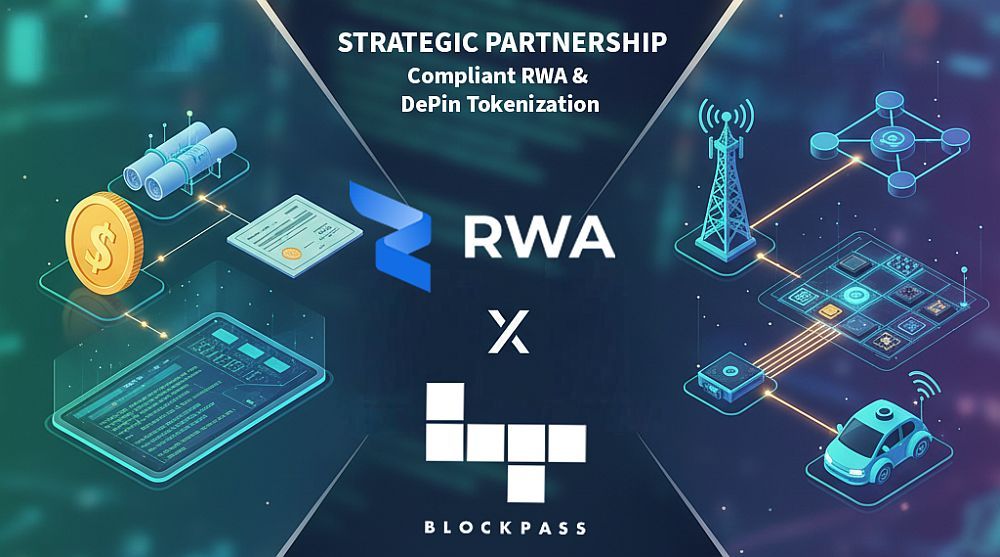
Launch.rwa.inc is an all-in-one investor platform with inbuilt referral system, for raising funds and launching tokens, revolutionizing the way in which real-world assets can be invested and traded and provide passive income for the RWA ecosystem. RWA Inc provides the tools, services, and support that users need to successfully navigate the decentralized economy and benefit from new avenues of investment. With a focus on trust and security, alongside accessibility and innovation, RWA Inc offers diverse ways to participate in the ecosystem, from Initial DEX Offerings (IDOs) and private sales to staking and community-driven crowdfunding. The platform facilitates the launch, scaling and management of projects, enabling token minting, liquidity and trading solutions and more in a secure, efficient, and compliant manner. Whether new to blockchain or a seasoned investor, RWA’s features, such as an intuitive interface, robust security features, and helpful support team, ensure a smooth experience for all involved.
Blockpass, the Safe Network for Crypto™, has pioneered reusable identities and crypto-native KYC/AML solutions. Its turnkey suite of compliance tools is designed to lower onboarding costs, automate remediation, prove humanity and protect against malicious actors, fraudulent activities, bots, and AI. Businesses can set up services quickly, test them for free, and start verifying users. With around one million verified identity profiles, Blockpass facilitates instant onboarding, and to date over a thousand businesses have taken advantage of this opportunity to benefit from Blockpass’ compliant network. With the recent addition of On-Chain KYC® 2.0, businesses are now empowered to create verified, reusable digital identities for users, both on the blockchain through on-chain attestations, or off the blockchain through zero-knowledge proofs, providing a single, interoperable and simple solution for dApps and other platforms.
“At RWA Inc, trust is not a slogan — it is the currency that underpins every transaction, every relationship, and every tokenized asset we bring on-chain. We understand that institutional and retail investors alike will only participate in the tokenized economy if they can trust that the data, assets, and issuers behind each token are fully verified and compliant.
Our mission, therefore, is to engineer verifiable trust – transforming blockchain from a speculative ecosystem into a transparent, regulated, and investable infrastructure for real-world assets.” Kevin Yunai, RWA Inc. Founder and CEO said.
Blockpass CEO, Adam Vaziri, added, “We’re delighted to be partnering with exactly that type of solution with RWA Inc., and knowing their priorities around security and compliance align so closely with ours makes working with them even more of a pleasure.”
Through this collaboration, Blockpass and RWA create a secure and trusted ecosystem for individuals and businesses to interact in – a key cornerstone for the future as crypto and blockchain continue to expand. With safety, security and compliance paramount, both RWA and Blockpass make sure that everyone on both sides of the process has everything they need to leverage the amazing potential of this growing technology to bring new opportunities to the world of fundraising and investment, and to support startups and scaleups alike.
About RWA Inc.
RWA Inc. specializes in connecting funders to premium Real World Asset (RWA) and Decentralized Physical Infrastructure Network (DePIN) startups. Through our platform, funders can access carefully vetted projects to which we have provided advisory, acceleration and go-to market support. We facilitate different fundraising opportunities for clients. Our formats create investment opportunities for anyone interested in participating in RWA and DePIN startups, staying true to our mission of creating global accessibility to RWA investments. For more information, please visit https://www.rwa.inc.
About Blockpass
Blockpass offers a comprehensive, cost-effective suite of KYC, KYB, and AML compliance solutions for Web3. Built by compliance and crypto experts, our tools lower onboarding costs, automate processes, and protect against fraud. Our core products include our groundbreaking On-Chain KYC® 2.0 for verified, reusable digital identities via on-chain attestations and zero-knowledge proofs, the Advanced KYC Bot™ for automated onboarding, Unhosted Wallet KYC™ for wallet ownership certification, and Travel Rule Hub for fulfilling crypto transfer regulation.
We also provide specialized solutions like Launchpad KYC for crypto platforms servicing multiple token offerings, SAFT KYC for private token sales, and Node Sale KYC to verify node participants and prevent fraud. Our Outsourcing services offer expert personnel for compliance management. With a network of more than a million pre-verified crypto investors and more than three thousand crypto VCs, businesses can achieve instant onboarding and accelerate growth. Blockpass is a trusted partner for industry leaders like Animoca Brands, Cardano, and Polygon, helping to build the Safe Network for Crypto™.
Learn more and engage the Blockpass team:
Website: http://www.blockpass.org
Book a Demo: https://www.blockpass.org/book-your-call/
Email: [email protected]
Distributed By ACNWIRE
Uncategorized
FSH Technologies Raises $25 Million to Take On The Consulting Firms Running Up The Bill on American Taxpayers
PHILADELPHIA, PAThe company is taking its bill-by-results model nationwide, up against the consulting firms and point-solution vendors that have run up the bill on American taxpayers for decades FSH Technologies, which builds software for cities, school districts and state agencies to replace outdated, slow-moving government IT systems, today announced $25 million in total funding. That includes a […]
PHILADELPHIA, PA
The company is taking its bill-by-results model nationwide, up against the consulting firms and point-solution vendors that have run up the bill on American taxpayers for decades
FSH Technologies, which builds software for cities, school districts and state agencies to replace outdated, slow-moving government IT systems, today announced $25 million in total funding. That includes a $20 million Series A led by Lachy Groom, an early backer of Figma, Notion, Ramp and Lattice, with Acrew Capital co-leading and Operator Partners, Contrary, Cooley and several angels also participating. The round follows an earlier $5 million seed led by Contrary with Acrew Capital, General Catalyst, Scribble Ventures and Basis Set Ventures joining.

“Bill-by-the-hour is why consulting can never lead to government efficiency,” said Lilly Chen, founder and CEO of FSH. “We built the opposite model. We only grow when a city or school district loves our solution and expands the scope, so the incentive is to build something that works, not to stretch out the invoice.”
Chen previously worked as an AI/ML engineer at Meta before advising on Philadelphia’s mayoral transition team, where she saw firsthand how city procurement decisions get made, and who they fail. Before that, she spent time as a Buddhist monk and professional video game player. The company’s name comes from a saying she carried out of that period: be the pond, not the fish — look at the whole picture, not one problem in isolation.
FSH’s model is already replacing the two kinds of vendors that dominate the $160 billion state and local government IT market: consulting firms that bill by the hour, where a slow project is more profitable than a fast one, and point-solution vendors that get bought up by private equity and coast on renewal fees. Pittsburgh Public Schools moved to FSH after a security vulnerability in its previous vendor exposed student data. Buffalo made a similar switch after years on a system that had simply stopped keeping up. When a Philadelphia tax law change left thousands of small businesses suddenly owing a new city tax, FSH stood up a support program in a single month that reached more than 1,000 businesses in 13 languages, most filing for the first time.
“GovTech is a notoriously difficult space because people think bureaucracy is a grind. Lilly and the FSH team obsessively enjoy solving what everyone else thinks is boring. It takes that level of intense optimism to change something that’s always been broken,” said Lachy Groom.
FSH has grown revenue inside more than 30% of its existing accounts, for a 1,340% increase across that group. After activating its expansion strategy in the second quarter of 2026, the company’s own annual recurring revenue grew sevenfold. FSH projects reaching $450 million in annual recurring revenue by 2028. The company is now taking the model nationwide, expanding from its current base in Buffalo, Denver, Philadelphia and Pittsburgh with a goal of operating in all 50 states within the year, adding categories including EMS and police scheduling, transit management and case management along the way.
Lilly Chen is joined by COO Jason Chen, who spent six years as a Partner at Contrary after starting his career at PwC, and CTO Rodda John, who led Ramp’s 20-person engineering team behind billpay.com before co-founding Moab, an ERP startup for equipment rental companies.
The new funding will go toward product development, sales growth, and hiring, taking FSH’s team from 11 to more than 45, primarily in engineering, design and client strategy. FSH’s long-term goal is to make government software work, by default.
About FSH Technologies
FSH Technologies builds software for governments and school districts nationwide, replacing hourly-billed consulting firms and point-solution vendors with a single platform that only grows when the software actually works. FSH currently serves Buffalo, Denver, Philadelphia and Pittsburgh, among other locations, with plans to expand to all 50 states.
Media Contact Details
Outlier Partners | Lauren Wallack-Estes
FSH Technologies
Email: Send Email
Uncategorized
S99 PR Announces Signal Press Framework as AI Search Reshapes Brand Discoverability
LOS ANGELES, Calif.Agency outlines an AEO-focused public relations strategy built around recurring third-party visibility as consumers and business buyers increasingly use AI assistants for research S99 PR, a public relations and authority-building agency specializing in guaranteed media placements and AI discoverability, has announced an expanded focus on Answer Engine Optimization (AEO) through its Signal Press framework as artificial […]
LOS ANGELES, Calif.
Agency outlines an AEO-focused public relations strategy built around recurring third-party visibility as consumers and business buyers increasingly use AI assistants for research
S99 PR, a public relations and authority-building agency specializing in guaranteed media placements and AI discoverability, has announced an expanded focus on Answer Engine Optimization (AEO) through its Signal Press framework as artificial intelligence platforms become a growing part of how consumers and business buyers research companies, products and professionals.

Platforms including ChatGPT, Claude and Perplexity are increasingly being used to answer questions that historically might have begun with a traditional search engine. Instead of presenting users only with ranked links, AI systems can synthesize information from multiple sources and provide direct responses that may include specific brands, companies or professionals.
S99 PR said the shift has created a new challenge for organizations accustomed to focusing primarily on traditional search engine optimization.
“We started hearing the same question on sales calls, and it came from people who had never asked us anything technical before,” said Jake Vince, co-founder of S99 PR. “A founder would say, ‘I asked ChatGPT about my own company and it either said nothing or it said something wrong.’ That question went from rare to constant in about six months.”
The agency’s AEO strategy is focused on helping companies build a broader and more consistent public information footprint through third-party publications, press coverage, company positioning and recurring communications.
Research Highlights Changing Patterns in AI Search
Recent industry research suggests that traditional search rankings and AI-generated recommendations do not always follow the same signals.
An analysis involving approximately 75,000 brands found that off-site brand signals, including branded web mentions and visibility across third-party platforms, showed stronger relationships with AI visibility than traditional backlink metrics alone.
Separately, research examining millions of links cited by major AI systems reported that approximately 84% of citations came from earned media sources, while paid or advertorial material represented approximately 0.3% of the citations analyzed.
S99 PR said the findings reinforce the importance of distinguishing between what a company says about itself and information that appears through independent or third-party sources.
“Companies have spent years optimizing the assets they directly control,” Vince said. “But AI systems also look across a much broader information environment. A company’s own website remains important, but third-party references can provide additional context about who a company is and how it is described publicly.”
Research into third-party distribution has also found differences in AI citation behavior depending on where content appears.
An earlier controlled study comparing identical content on owned websites and third-party news distribution reported citation rates increasing from approximately 8% to 34%, representing a 325% increase in that pilot dataset. A later, broader study examining more brands and prompts reported a 239% median increase in AI citations following earned-media distribution.
These findings do not mean every article, press release or third-party placement will generate the same result. Citation behavior differs across AI platforms, topics, sources and individual queries.

AI-Referred Traffic Shows Different User Behavior
The shift is not limited to visibility.
Industry research has also suggested that visitors arriving through AI-generated recommendations can behave differently from traditional organic-search visitors.
Semrush research has estimated that AI-referred visitors converted at approximately 4.4 times the rate of traditional organic-search visitors within the dataset studied.
In April 2026, G2 reported that 51% of surveyed B2B software buyers said they begin product research with an AI chatbot more often than with Google.
S99 PR said these trends are encouraging companies to consider AI visibility alongside traditional search visibility, media relations and brand reputation.
Google Rankings Do Not Fully Predict AI Visibility
Traditional SEO remains an important part of digital marketing, but research indicates that strong Google rankings do not necessarily guarantee equivalent visibility in AI-generated answers.
One controlled study examining Google positions and ChatGPT recommendations reported a correlation of 0.034 within its tested dataset, indicating very little relationship between the two ranking environments in that particular analysis.
S99 PR said the difference reflects the contrasting ways traditional search engines and generative AI platforms present information.
Traditional search primarily ranks and organizes pages. Generative AI systems may instead synthesize information from multiple sources when creating an answer.
As a result, S99 PR’s AEO work focuses on building consistent public references across multiple sources rather than treating a company’s own website as the only source of authority.
“Get real publications to write about you. Do it consistently. Say the same thing about who you are every time,” Vince said. “That was good advice before AI search became part of the conversation, and it remains relevant as companies think about how their public information is interpreted across new platforms.”
Signal Press Framework Focuses on Consistency
S99 PR developed its Signal Press framework around the idea that brand visibility should be built continuously rather than treated as a single campaign.
The framework combines recurring editorial placements, wire-distributed press releases and supporting article coverage intended to create a more consistent public information footprint over time.
Rather than relying on a single media placement, the approach focuses on maintaining continuity across company announcements, founder profiles, executive positioning, business developments and other public-facing content.
“A single article can remain valuable for years to a human reader,” Vince said. “But AI search adds another reason for companies to think about consistency. The objective is to create a clear and current body of information that both people and technology systems can encounter when researching a company.”
S99 PR does not represent that recurring coverage guarantees inclusion in ChatGPT, Claude, Perplexity, Google AI products or any other artificial intelligence platform. AI visibility depends on the individual platform, query, available sources and other factors outside the agency’s control.
Third-Party Coverage and Guaranteed Media Placements
S99 PR provides guaranteed media-placement services alongside broader public relations and authority-building programs.
The agency said its placement standards focus on recognized publications, identifiable attribution, visible publication information and professionally formatted editorial content.
S99 PR also distinguishes its guaranteed placement services from conventional earned media. Research findings concerning earned editorial coverage should not be interpreted as proof that every paid, sponsored or guaranteed placement will generate the same AI citation behavior.
Instead, the agency’s strategy is based on building a broader mix of credible public information around companies and individuals while maintaining consistency in how key facts, credentials and business developments are communicated.
Supporting Founders, Executives and Professional Brands
S99 PR’s media and AEO programs serve clients including:
- Startup founders and co-founders
- CEOs and other executives
- Technology and AI professionals
- Medical professionals
- Real estate professionals
- Financial professionals
- Entertainment figures
- Consumer-brand founders
- Public figures
The agency also operates a dedicated immigration-related press practice supporting O-1 and EB-1A extraordinary ability visa applicants in coordination with immigration attorneys.
Across these areas, S99 PR said the goal is to help clients develop a more complete public record through company announcements, media coverage, executive positioning and other third-party references.
Building Authority Across Search and AI Platforms
S99 PR’s broader services include guaranteed media placements, press-release distribution, Google Knowledge Panel development, contributor-profile programs and authority-building campaigns.
The agency’s strategy is based on the view that public relations increasingly affects several areas simultaneously: traditional search visibility, AI discoverability and the way prospective customers, investors, partners and other audiences evaluate credibility.
“Public relations is no longer only about getting your name into an article,” Vince said. “Companies now need to think about the full information environment around their brand—what appears in search, what third-party publications say and what AI platforms may encounter when they try to understand who that company is.”
S99 PR said it plans to continue developing its AEO and Signal Press programs as research into AI citation patterns, answer engines and generative search continues to evolve.
More information about S99 PR’s guaranteed media placements, AEO programs and authority-building campaigns is available at www.s99pr.com.
About S99 PR
S99 PR is a public relations and authority-building agency specializing in guaranteed media placements, digital credibility, Google Knowledge Panels and authority-building campaigns for founders, executives and brands.
The company works with clients across technology, artificial intelligence, healthcare, entertainment, finance, real estate and consumer-brand sectors and also maintains a dedicated practice supporting press strategies for O-1 and EB-1A extraordinary ability visa applicants.
Website: www.s99pr.com
Research and Results Disclosure
Statistics referenced in this release are based on third-party industry studies involving specific datasets, platforms and research methodologies. Findings should not be interpreted as universal performance guarantees for every company, publication or AI platform.
AI-generated recommendations and citations can vary based on user prompts, model versions, retrieval methods, source availability and other factors. S99 PR does not control or guarantee how ChatGPT, Claude, Perplexity, Google or other AI/search platforms rank, cite, summarize or recommend individual brands.
Guaranteed media placement refers to S99 PR’s publication service and should not automatically be equated with independently earned editorial coverage. Individual publications may apply their own editorial, disclosure and content standards.
Media Contact Details
Jake Vince
S99 PR
Email: Send Email
Phone: +1 (323) 214-3019
Website: s99pr.com
Uncategorized
First Phosphate Positions North American LFP Supply Chain for Next Phase of Battery Growth
NEW YORK, USACompany advances vertically integrated strategy spanning high-purity phosphate resources, purified phosphoric acid and LFP battery materials as demand expands across energy storage, AI infrastructure and electric mobility.
Company advances vertically integrated strategy spanning high-purity phosphate resources, purified phosphoric acid and LFP battery materials as demand expands across energy storage, AI infrastructure and electric mobility.
NEW YORK, USA
First Phosphate Corp. (Nasdaq: PHOS; CSE: PHOS) is advancing a vertically integrated North American strategy designed to address one of the critical inputs in the rapidly growing lithium iron phosphate (LFP) battery market: high-purity phosphate.

As LFP technology expands across large-scale energy storage, artificial intelligence data centers, electric vehicles, telecommunications, robotics, industrial automation, defense and other applications, First Phosphate is positioning its Québec-based phosphate resources and downstream processing strategy to participate across multiple stages of the battery supply chain.
The company’s strategy begins with its flagship Bégin-Lamarche project in Québec, which hosts a large-scale igneous phosphate resource. Unlike sedimentary phosphate deposits commonly associated with fertilizer production, First Phosphate is focused on high-purity igneous phosphate that the company believes is particularly suited for conversion into purified phosphoric acid and ultimately LFP battery materials.
Building a Vertically Integrated LFP Supply Chain
First Phosphate’s strategy is designed to capture value across the LFP production process rather than operate solely as a traditional mineral developer.
The company has outlined a supply chain extending from igneous anorthosite phosphate rock through high-purity phosphate concentrate, purified phosphoric acid, iron phosphate precursor, LFP cathode active material and ultimately LFP battery cells.
This approach comes as governments, manufacturers and investors increasingly focus on securing domestic sources of critical minerals and reducing dependence on overseas battery supply chains.
First Phosphate’s investment materials indicate that Bégin-Lamarche contains approximately 255 million tonnes of indicated and inferred mineral resources.
According to the company’s Preliminary Economic Assessment, the project is designed around approximately 900,000 tonnes per year of phosphate concentrate production at approximately 40% P₂O₅. The company reports a pre-tax NPV of approximately CAD $2.1 billion and pre-tax IRR of 37.1%, while the after-tax NPV is approximately CAD $1.59 billion with an after-tax IRR of 33.0%. The estimated after-tax payback period is approximately 2.9 years.
These figures are preliminary projections and remain subject to the assumptions, risks and qualifications contained in the company’s technical and regulatory disclosures.
LFP Demand Moves Beyond Electric Vehicles
A central component of First Phosphate’s investment thesis is that LFP batteries are no longer primarily an electric-vehicle story.
The company points to growing applications across large-scale energy storage, AI data centers, telecommunications infrastructure, EV charging stations, consumer products, robotics and factory automation, marine and agricultural applications, defense and electric mobility.
LFP chemistry has gained attention because of its thermal stability, long cycle life, relatively low degradation and competitive input costs.
First Phosphate has already advanced downstream development through its LFP cathode active material and battery-cell initiatives, including production of LFP battery cells using North American-sourced critical minerals.
As AI data centers and large-scale energy storage systems require increasingly sophisticated power and backup-energy infrastructure, the addressable market for LFP technology could extend well beyond passenger EV adoption.
Phosphate Emerges as a Strategic Battery Material
While lithium has traditionally dominated discussions surrounding battery supply chains, phosphate represents a significant component of LFP chemistry.
First Phosphate’s strategy highlights the importance of securing reliable sources of battery-grade phosphate and purified phosphoric acid as LFP manufacturing expands.
The company believes Western markets face limited battery-grade purified phosphoric acid capacity, creating an opportunity for North American producers capable of supplying high-purity material at scale.
First Phosphate is seeking to address that opportunity through a mine-to-market strategy connecting its Québec mineral resources with downstream processing and battery-material partnerships.
Commercial Partnerships and Project Development
First Phosphate has focused on establishing relationships throughout the battery value chain, including phosphate processing, purified phosphoric acid production, iron phosphate precursor manufacturing, cathode active material development and battery-cell production.
The company reports firm offtake arrangements covering at least 200,000 tonnes annually of phosphate concentrate and 60,000 tonnes annually of phosphoric acid, creating a potential commercial pathway for future production.
In January 2026, First Phosphate also announced an initial payment under its long-term phosphate concentrate offtake arrangement to assist in advancing Bégin-Lamarche toward feasibility and an eventual production decision.
Government support has become another component of the project’s development strategy. In March 2026, First Phosphate finalized an agreement for a CAD $16.7 million non-repayable contribution from the Government of Canada through Natural Resources Canada.
The funding is intended to support technical and engineering work associated with producing phosphate concentrate that meets LFP battery-market requirements.
Building a North American Critical-Minerals Platform
First Phosphate’s broader opportunity sits at the intersection of electrification, energy security and rapidly growing power-intensive digital infrastructure.
As battery demand grows, LFP is increasingly being considered for applications where safety, longevity, cost efficiency and reliability can be more important than maximizing energy density.
First Phosphate’s strategy is therefore not simply to extract phosphate. The company is seeking to develop an integrated ecosystem capable of moving material from a Québec mineral resource through processing and ultimately into North American LFP batteries.
Its partnerships, offtake agreements and government support are intended to help reduce development risk as the company progresses toward feasibility, permitting and potential investment decisions.
Looking Ahead
Upcoming milestones are expected to include advancement of feasibility studies, permitting, downstream processing decisions and further development of commercial and financing relationships.
Investors and industry stakeholders can follow the company’s latest corporate developments and announcements or access its Investor Relations resources for corporate presentations, securities information, public filings and research coverage.
If successfully executed, First Phosphate’s vertically integrated model could position the company within an emerging North American supply chain for one of the battery industry’s fastest-growing chemistries.
With energy storage, AI infrastructure, electric mobility and industrial electrification creating new sources of battery demand, First Phosphate is advancing the case that the next critical-minerals opportunity may not be defined by lithium alone — but also by the phosphate required to manufacture LFP batteries at scale.
About First Phosphate Corp.
First Phosphate Corp. is a critical-minerals company focused on integrating high-purity phosphate resources into the North American lithium iron phosphate battery supply chain. The company is developing its Bégin-Lamarche phosphate project in Québec and pursuing a vertically integrated strategy spanning phosphate concentrate, purified phosphoric acid and downstream LFP battery materials.
Media Contact Details
Liana Zavo
Email: Send Email

FSH Technologies Raises $25 Million to Take On The Consulting Firms Running Up The Bill on American Taxpayers
S99 PR Announces Signal Press Framework as AI Search Reshapes Brand Discoverability
First Phosphate Positions North American LFP Supply Chain for Next Phase of Battery Growth

Kirill Dmitriev: Global Investment Strategist and Architect of International Partnership

Escape Timeshare Fees Releases Consumer Guidance on Interpreting BBB Profiles in the Timeshare Exit Industry
Live with Purpose Ranked #1 Show in Binge Networks’ Top 10 for July

Germany’s ports and China: How to reconcile openness, resilience and security?

Cubic Introduces DTECH Fusion Edge High-Performance Compute (eHPC) at Special Operations Forces Week

The Global economy is more vulnerable than it seems. World leaders appear largely unwilling to invest in preserving global economic integration
-
 Uncategorized11 months ago
Kirill Dmitriev: Global Investment Strategist and Architect of International Partnership
-
 Uncategorized8 months ago
Escape Timeshare Fees Releases Consumer Guidance on Interpreting BBB Profiles in the Timeshare Exit Industry
-
Uncategorized1 year ago
Live with Purpose Ranked #1 Show in Binge Networks’ Top 10 for July
-

 Uncategorized8 months ago
TreasureNFT: Partnering with BlackRock Capital for a Major Upgrade – NOVA Platform Aims to Become the World’s Largest NFT Trading Ecosystem
-

 Entertainment & Sports2 years ago
Rachael Sage Releases Powerful Reimagined Acoustic Album, Another Side
-
Uncategorized1 week ago
Legal Complaint Filed Against Rwandan Government Over Secret $404.7 Million Road Contract Awarded to Ruling Party’s Business Conglomerate
-

 Business1 year ago
Aivista Quant Capital CEO Dr. Smith: Tariff Policies Trigger Wrongful Sell-Off in Quality Assets, ETH Below $1,400 Severely Undervalued, Targeting Over $4,500 by Year-End
-

 Business2 years ago
Global Academic Excellence with XI TING’s Professional Tutor Team