
Uncategorized
“ Dome Living, Digital Layers, and Decentralized Life — Through Mayan’s Eyes ” — With Marco Derhy


In a world rebuilding itself from the ground up, few visions feel as elemental — and as elegant — as TerraLux. At the intersection of architectural beauty, biological intelligence, and digital myth-making, TerraLux isn’t just developing homes. It’s composing the symphony of a new Earth. From dome villages that breathe wellness into the soil, to AR story layers that turn land into legend, this movement is more than a blueprint — it’s a living dreamscape. I sat down with the creators behind TerraLux to explore how ancient geometry, luxury interiors, and Web3 technology are weaving together a regenerative future, one dome at a time.
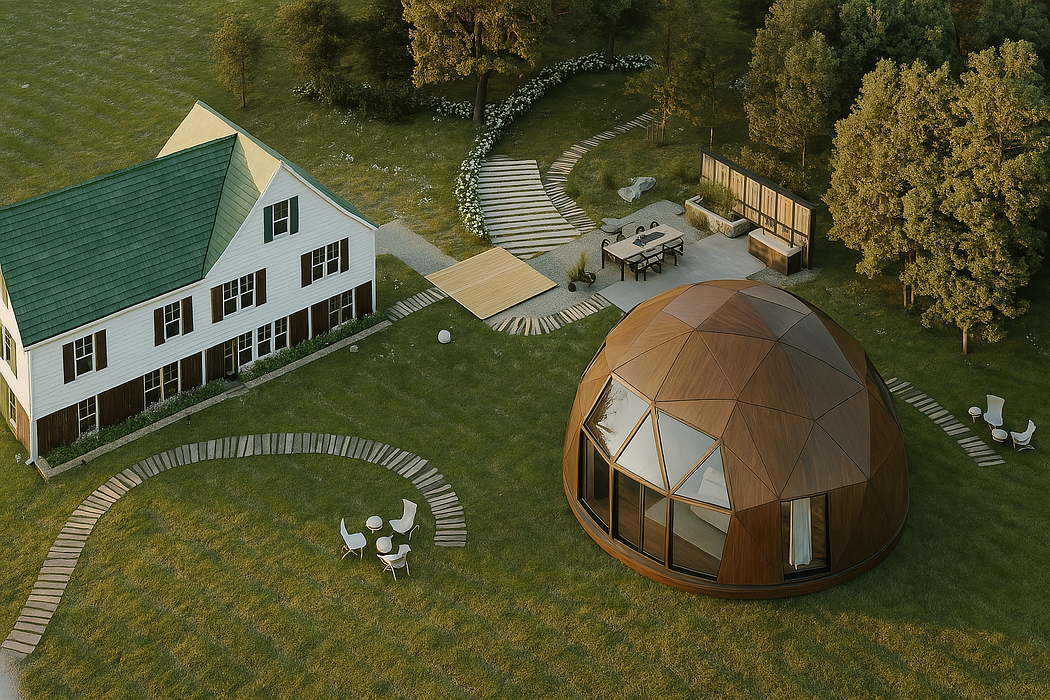 Dome design nested on a TerraLux property in the Catskill Mountains
 PART 1: THE CALLING
From luxury interiors to regenerative dome villages — what moment or insight sparked this pivot toward building a New Earth?
At the intersection of beauty and responsibility, a profound shift began. I’ve always held a deep reverence for the subtle patterns of life — how relationships form, how environments shape culture, and how even a single space can influence the soul of a community. Early on, luxury design allowed us to craft spaces of refinement and emotional resonance. But as our company matured, the question emerged: what if these same principles could be applied to the significant challenges of our time?
As I began to explore the tech sector — particularly AI, IoT, and the emerging frameworks of regenerative architecture — it became clear: the future wouldn’t be built with blueprints alone, but with integrated systems that listen, learn, and heal. This wasn’t just about designing homes — it was about creating new societal DNA.
The kitchen, once a symbol of family, has now become a gateway to sovereignty over health, energy, and data. The dome, once seen as an alternative to traditional architecture, became a system for planetary living.
With TerraLux, we’ve transitioned from crafting beautiful residences to building a replicable, intelligent ecosystem that combines wellness, innovative infrastructure, immersive storytelling, and responsible stewardship of the land.
We stand at a threshold where technology, design, and purpose converge — and the tools we now have allow us to answer a question that once felt unreachable: What does it look like to build the future, not just talk about it?
For us, that future isn’t abstract. It’s eight shovel-ready properties, an award-winning kitchen design legacy, and a growing network of dome communities ready to live differently. The time to act is now. And with TerraLux, we’re not just responding to that urgency — we’re architecting the timeline shift.
You’ve called this more than homebuilding — it’s a blueprint for life. How does that blueprint unfold across your eight properties?
Each of our properties is a living expression of place-based intelligence. From the forests of the Catskills to the tropical coastlines of the Dominican Republic, our blueprint begins by listening to the land. We study the climate, the biome, and the subtle ecological patterns already in motion. This allows us to design not just structures, but systems that enhance what’s already thriving.
Across our eight active properties, no two sites are alike, and that’s by design. Some are better suited for regenerative agriculture, others for wellness retreats, and others still for innovation hubs. Our process begins with ecological attunement and expands into social infrastructure.
We build spaces for vitality, collaboration, and cultural renewal. Inside, we integrate wellness technology that actively supports human biology. From frequency-based healing beds and AI wellness assistants to optimizing air, water, and light, each space becomes a sanctuary designed to evolve with its inhabitants.
The blueprint extends through every layer. Modular dome shells enable scalable growth. Our kitchens, built with award-winning design houses, offer personalized spaces powered by intelligent AI assistants and regenerative cooking systems. We even provide blueprints for 3D-printed tools and agricultural systems, encouraging a circular approach to innovation.
Take the Catskills site, for example. It’s home to a tech incubator where creators work at the intersection of nature and invention, supported by immersive eco-experiences and fully equipped digital labs. In contrast, our Dominican Republic site is grounded in somatic healing, yoga, equine-assisted therapies, and bodywork, offered in close connection to the natural rhythm of the land.
At every property, the TerraLux blueprint is more about resonance than replication. We design for the life that wants to emerge from each place.
One of your sites will host the Buckminster Fuller Dome Museum. What personal meaning does Fuller’s legacy hold for you and your work?
Buckminster Fuller was a visionary who blurred the lines between science, art, engineering, and philosophy. What inspires us most is how he used mathematical elegance and engineering precision in the service of humanity, not industry. His work wasn’t just about innovation for the sake of innovation; it was about solving global problems, reducing waste, and designing systems that improve life on Earth.
In Fuller’s domes, we see more than structures — we see biomimicry in action. The geodesic dome mirrors nature’s efficiency, strength, and adaptability. Unlike the rigid boxes that define so much of modern architecture, Fuller’s designs breathe with organic intelligence. His domes are lightweight yet strong, minimalist yet monumental, and deeply aligned with natural principles.
In a world dominated by extractive methods and square buildings, he built spheres — structures that used less material, covered more space, and invited a different relationship with the environment. Fuller dared to imagine a future where design wasn’t just functional, but regenerative — and we’re walking in those footsteps, striving to create dwellings and systems that harmonize with the planet rather than conquer it.
His philosophy reminds us that design is not neutral — it’s a tool for world-building. And like Fuller, we believe design should serve life.
PART 2: THE SYSTEMS
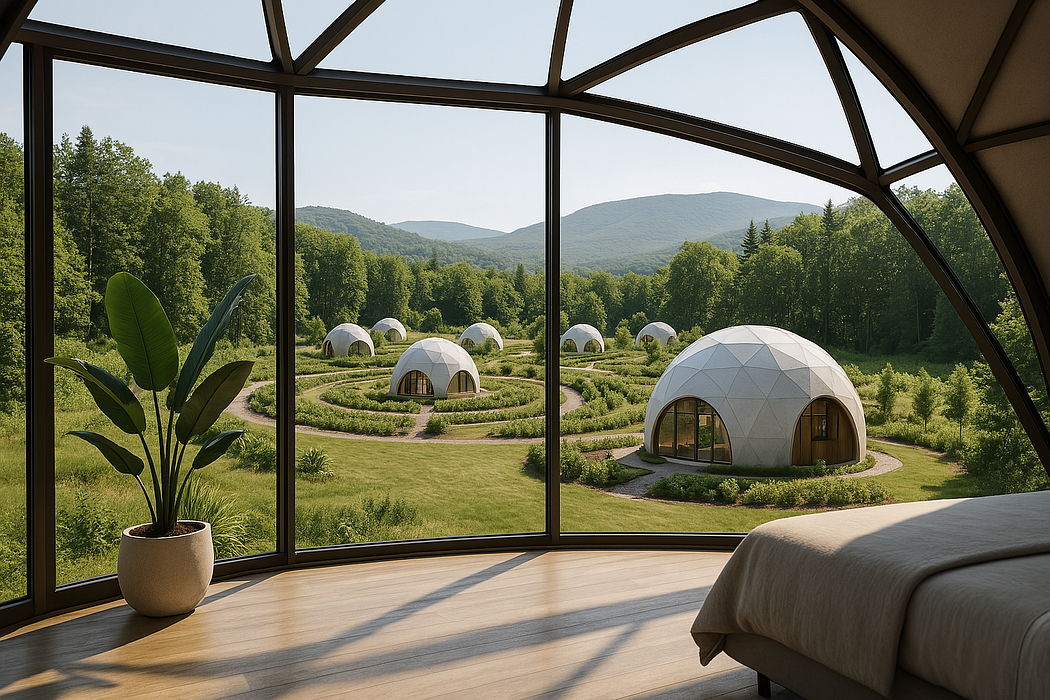 Vistas of the future with the ecovillage design
 Each dome features luxury kitchens designed by world-class names like Leicht and Charles Yorke. Why was it important to blend regenerative design with uncompromising interiors?
At TerraLux, we see adoption as the accurate metric of impact. A sustainable future will only take root if it’s compelling enough to live in. That’s why we’ve focused so intently on marrying ecological intelligence with aesthetic excellence. It’s not about sacrifice — it’s about alignment.
Luxury design plays a vital role in cultural signaling. When people walk into a space that feels elevated, nourishing, and refined, they’re more likely to stay, return, and reimagine what’s possible. By integrating brands like Leicht and Charles Yorke — names known for their craftsmanship and timelessness — we’re showing that regenerative living can also be aspirational, even exquisite.
We also have a deep personal connection to design as an art form. These interiors aren’t simply functional. They carry the legacy of material mastery, of form guided by feeling. We aim to ensure these traditions evolve into the future, not get left behind in the rush toward automation or austerity.
Every dome we build becomes a bridge, where the intelligence of nature meets the sophistication of human creativity. When people feel that balance under their feet, in the light, the textures, the flow of the kitchen, they begin to understand that regeneration isn’t an alternative lifestyle. It’s the foundation of a more meaningful one.
With eight properties already shovel-ready across the globe, how do you decide where and how TerraLux expands its next node?
Site selection at TerraLux is driven by both ecological diversity and cultural momentum. Each new property offers an opportunity to refine how our smart systems adapt to different climates, topographies, and bioregions. We’re always asking: how can the architecture respond more intuitively to the land, and what can the land teach us about evolving the system?
At the same time, we operate within a living network of collaborators. Our model is agile by design, shaped by strategic partnerships across construction, smart tech, land development, and community organizing. Expansion isn’t just about geography — it’s about synergy. We stay tuned to where new patterns are emerging, where people are ready to co-create, and where our technologies can enhance what’s already growing.
Our existing eight properties are more than standalone projects — they’re our laboratories. Each site contributes unique data and insights across biome types, social dynamics, and infrastructure integration. What we learn in the Catskills informs how we design for the tropics. What emerges in Greece influences how we approach development in drier zones. This distributed intelligence is what gives us the confidence to scale. When we move toward a ninth site, it isn’t a leap into the unknown — it’s a continuation of an iterative, evolving process grounded in real-world feedback.
Right now, regions like Costa Rica and Dubai are showing signs of accelerated convergence — visionary investors, values-aligned communities, and forward-thinking infrastructure. These are not just emerging markets. They’re becoming testbeds for a redefined way of living. What guides us most is listening across ecosystems, industries, and cultures. Our intention isn’t to impose a model, but to offer tools and frameworks that integrate well and uplift the natural rhythm already in motion.
Your Spatial Network reimagines land as a living map. How does this platform support dome builders and landowners in building regenerative futures?
The Spatial Network gives form to vision. It allows landowners, designers, and community builders to see their property not as a static asset but as an evolving system. By placing intuitive mapping tools in the hands of users, we make it possible for anyone to prototype a regenerative project — layering infrastructure, agricultural zones, wellness centers, or communal spaces — and begin sharing that vision with collaborators, funders, and planners in real time.
One of the features we’re most excited about is our new timeline slider. It allows users to anchor their land plans across multiple stages of development, including speculative future phases. This means projects can be visualized dynamically, not just as they are today, but as living trajectories that evolve. It creates a new dimension of storytelling for land — a way to invite stakeholders into the process before the ground is even broken.
Another integral feature is the bioregional report. This tool automatically analyzes the surrounding ecosystem and socio-cultural context, offering tailored insights on how to develop with ecological harmony in mind. From local climate data to emerging land-use trends, we provide a nuanced foundation for design decisions rooted in place-based intelligence.
What sets this platform apart is its collective awareness. As the network grows, our AI systems begin to recognize patterns across properties — shared goals, complementary needs, potential synergies. That allows us to pair users intelligently, suggest collaborations, and coordinate momentum between like-minded builders. It’s a digital nervous system for regenerative development, ensuring that each project works in isolation, but as part of a greater movement.
The partnership with HomeLink brings advanced smart tech into every dome. What role does intelligent automation play in creating homes that heal?
Our partnership with HomeLink allows us to build on an exceptional foundation of smart infrastructure. Their technology manages the core essentials of intelligent living — from personalized environmental settings to seamless security and device integration. What makes the collaboration so powerful is how it allows us to go further, layering in wellness intelligence that transforms a home from simply responsive to actively regenerative.
At TerraLux, we see the home as a living organism. Intelligent automation becomes the interface through which the home learns from its inhabitants, offering nutritional guidance, monitoring biometrics, regulating air and water quality, and tuning light, sound, and electromagnetic fields to support optimal wewellbeingIt’s not about gadgets — it’s about crafting a space that knows how to support life on every level.
The current wave of AI development is what makes this vision actionable. We now have the tools to parse vast datasets, identify patterns, and deliver hyper-personalized support in real time. Each dome becomes its feedback loop, adjusting to the needs of the people within it and creating tailored environments that align with their biology, routines, and long-term health goals.
We’re integrating emerging modalities such as resonance therapy, bioscanning, and longevity-focused protocols directly into the system architecture. As this field continues to evolve, each breakthrough becomes immediately accessible to our residents, connecting them to the forefront of personalized wellness and next-generation living. In a time when stress, overstimulation, and disconnection have become commonplace, our domes offer something different: intelligent environments designed to restore, support, and heal as part of everyday life.
Wellness isn’t just an add-on here — it’s the infrastructure. From frequency beds to AI wellness mirrors, how do TerraLux homes support biology at the deepest level?
At TerraLux, wellness is foundational to our building process. Each home is designed as a responsive environment, integrating technologies that align with biological rhythms and enhance quality of life in subtle, intelligent ways. Air and water purification systems, circadian lighting, and EMF zoning create a clean, supportive baseline for daily living.
In the kitchen, AI-driven companions assist with meal planning and nutritional awareness, adapting suggestions in real-time based on biometric feedback from wearables. Hydration systems deliver filtered, mineral-enhanced water, supporting health at a cellular level while creating a ritual of care within the home.
Our wellness bathrooms and bedrooms are equipped with scientifically grounded features such as red and near-infrared light therapy, environmental controls, and optional neurofeedback tools to support stress recovery, sleep quality, and mood regulation. These components are modular and user-directed, allowing for a tailored approach depending on resident preferences and needs.
The result is a home that gently collaborates with its inhabitants, quietly optimizing key inputs such as light, air, water, and recovery cues to support long-term well-being. Rather than layering tech on top of design, we integrate it at the structural level, ensuring that each space functions not only beautifully but regeneratively.
PART 3: THE EXPERIENCE
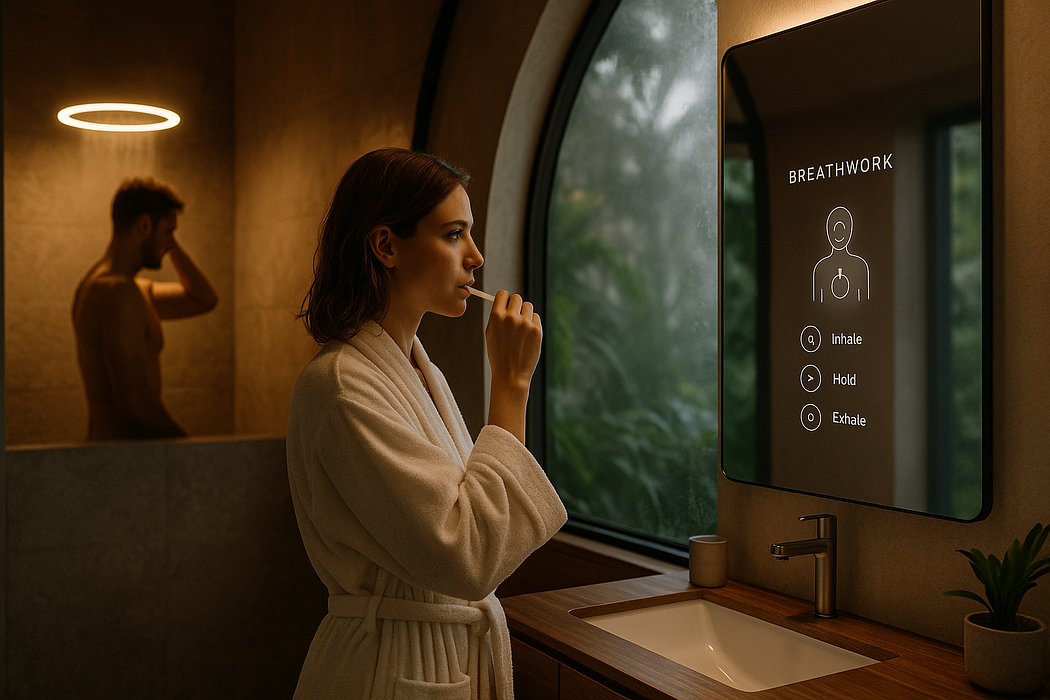 Homelink hardware and TerraLux software make a perfect marriage
 Every TerraLux site has an AR story layer — turning land into a mythic journey. How does gamifying space change how people relate to place?
When we’re young, space is alive. A hallway becomes a racetrack, a tree becomes a gateway, a kitchen becomes a castle. We crawl into corners, invent quests in gardens, and feel the world as a story unfolding around us. As we grow older, much of that wonder is flattened by utility. Places become functional. Land becomes real estate. The enchantment fades.
At TerraLux, we’re reclaiming that sense of living narrative — reviving the emotional, cultural, and mythic threads that connect people to place. Our AR story layers weave interactive journeys through each site, unlocking histories, rituals, folklore, and ecological insights that might otherwise remain invisible. These aren’t generic overlays — they’re crafted with deep research into local traditions, oral histories, and the environmental character of the land itself.
When visitors or residents explore a TerraLux village, they might scan a tree and discover the medicinal uses it once held, or follow a trail that leads them into a quest tied to the site’s founding story. These experiences stir memory and imagination, inviting people to participate in a shared mythology rather than pass through as observers.
The phygital layer, (where digital artifacts correspond to physical sites), creates personal stakes in the land. Residents and investors don’t just own space. They inhabit a living world, with characters, chapters, and are given a role to play in its ongoing story.
By integrating game design principles — exploration, achievement, cooperation, and meaning — we create places that are felt, not just visited. The result is a culture of playfulness and reverence, where the land itself becomes a teacher, a companion, and a stage for transformation.
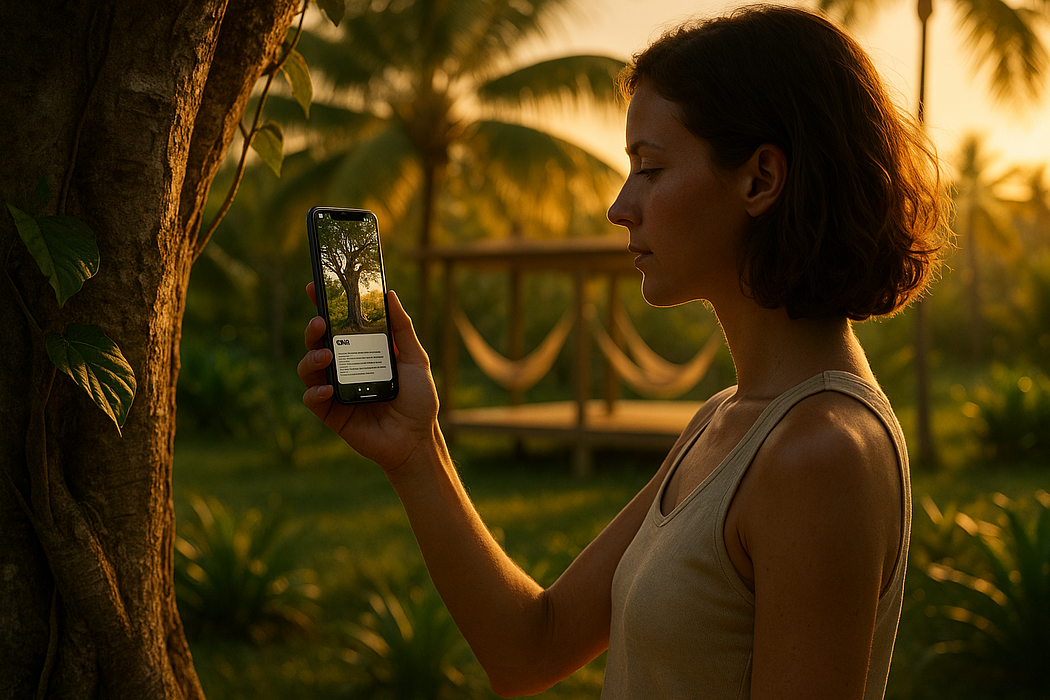 Explore the augmented reality story layers over the land
 When someone steps into a TerraLux showcase dome, what do you want them to feel in their body, and believe about the future?
We want people to feel a sense of arrival, as though they’ve stepped into a future they didn’t know was already available. There’s a grounded elegance in these domes that communicates something quietly powerful: that real change doesn’t have to wait for policy shifts or massive infrastructure overhauls. It can begin at home.
The atmosphere is alive with subtle cues — clean air, responsive light, natural textures, soft acoustics, and spatial flow that feels intuitive to the body. It’s a sensory reminder that comfort and regeneration aren’t opposites. They’re allies. We hope that visitors leave with a felt sense of possibility. That a regenerative, tech-integrated, creatively rich lifestyle isn’t a luxury reserved for tomorrow — it’s a choice that can be made today. These domes are prototypes of a more meaningful kind of living. And here’s a little secret — they’re also community starter kits. Inside each one is a foundational set of systems for nourishment, healing, creative expression, and expansion. They’re modular, scalable, and built to grow with the people who inhabit them.
When you walk into a TerraLux dome, you’re not just entering a building. You’re stepping into a living blueprint — a seed for the next chapter of civilization.
With shell domes starting at $50K and requiring no permits, what shifts could we see in travel culture, rural development, and land access?
Real estate is evolving. It’s no longer just about fixed assets and long-term mortgages — it’s becoming fluid, responsive, and rooted in deeper values. With our accessible pricing structure and domes designed for easy deployment, we’re opening up new models of land use that meet two growing desires in parallel.
The first is a return to local sovereignty. More people want to live in bioregional alignment — investing in land they can steward, rather than just occupying it. Whether motivated by environmental responsibility, a longing for a deeper connection to place, or the appeal of building a life in nature without sacrificing digital connectivity, our dome villages support this shift. We provide the architectural shell and a suite of regenerative tools that empower individuals and communities to shape their environment with intention.
The second is the rise of flexible, membership-based living. Think of it as the evolution of the homestead and the co-working model colliding. Our dome network allows digital nomads, mobile professionals, and value-driven travelers to invest in a distributed lifestyle. By joining the TerraLux ecosystem, you’re not just buying a structure — you’re gaining access to a network of like-minded communities around the world. Whether through house swaps, co-living exchanges, or location-to-location residency programs, the world becomes more open while still aligned with your values.
Underpinning all of this is a shared infrastructure. When you invest in a single dome, you’re plugging into a wider system — one that supports your independence while amplifying your contribution. It’s a new real estate paradigm: one that honors both rootedness and movement, ownership and access, personal expression and collective design.
PART 4: THE COMMUNITY & FUTURE
Fractional ownership in TerraLux isn’t just about real estate — it’s about governance and empowerment. How is it reshaping the idea of community leadership?
Ownership at TerraLux is not a static title — it’s an invitation to help shape the culture and direction of the community. Whether it’s a conversation in a shared kitchen about how meals are prepared, or a cross-site dialogue through digital governance tools like DAOs, we’re exploring new ways for people to step into meaningful agency.
We recognize that leadership in this era is about more than hierarchy. It’s about presence, contribution, and a sense of personal stake. That’s why our model incorporates both emotional investment, through narrative, place-making, and shared rituals, and structural involvement, through tokenized ownership and collaborative decision-making platforms. With tools like The Spatial Network, residents and stakeholders can visualize the evolution of the property, pose ideas, and actively participate in long-term development planning.
By embedding agile governance systems, internal rewards mechanisms, and data-informed feedback loops, we create a culture of iteration and responsiveness. It allows us to track the real-world impact of decisions — from ecological outcomes to social cohesion — and adjust in real time. Governance doesn’t have to feel like a burden. It can be a process of ongoing realignment that draws on the collective’s internal resources, lived experience, and emerging expertise.
Ultimately, we’re building communities where leadership is distributed, transparent, and aligned with our values. TerraLux isn’t offering a finished utopia. We’re offering a framework to co-create something alive, accountable, and adaptive—a new kind of stewardship—where everyone has a role in writing the next chapter.
You’re opening TerraLux to global co-creators. What kind of movement is rising from this platform — and what excites you most about who’s showing up?
TerraLux sits at a rare intersection — blending regenerative architecture, advanced wellness systems, intelligent infrastructure, and tokenized ownership. This convergence draws contributors from across disciplines: system designers, biotech pioneers, real estate futurists, wellness practitioners, and creatives working at the frontier of immersive storytelling.
What excites us most is the depth and sincerity that are emerging. In the personal wellness space, we’re seeing inventors develop next-generation tools that bring clinical insights into the home, bridging biology, software, psychology, and the environment in entirely new ways. These systems are built for practical impact, designed to integrate seamlessly into daily life and deliver tangible support from day one.
We’re also encouraged by the quiet maturation within Web3. Beyond the noise, projects are emerging that are anchored in utility, accountability, and shared ownership. With on-chain governance evolving and tools like AI agents and no-code platforms becoming more accessible, the distance between idea and implementation is shrinking. What once required a whole team can now begin with a single conversation.
As urban density, economic instability, and ecological strain increase, more people are seeking ecosystems that feel both luxurious and grounded — places that support the body, ignite the mind, and restore a relationship with the land. TerraLux offers a platform to co-create that future, and the people showing up are doing so with bold imagination and deep intent.
This movement is grounded in innovation, guided by a return to value-driven design and meaningful collaboration. What’s emerging is a culture shaped by participation, where governance, technology, and creativity align with long-term well-being. We are discovering tools that are finally worthy of the scale of the challenges we face.
PART 5: THE ESSENCE
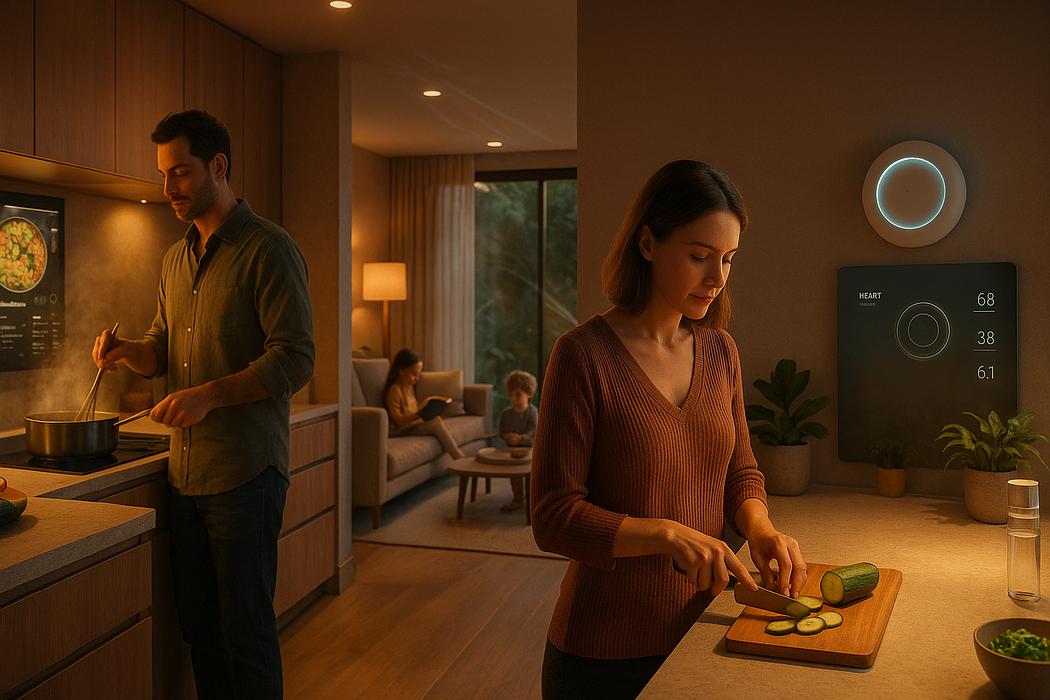 Smart homes with regenerative luxury — the future is available now
If someone remembers just one feeling or idea from experiencing TerraLux, what do you hope it is?
That a different kind of life is not only possible — it’s already here, waiting for them. We want people to feel the quiet joy of stepping into a space that welcomes them fully. Where the light feels intentional, the air feels clean, the systems respond to their needs, and something ancient in their body remembers how good it can feel to belong.
It’s the feeling of affluence without excess, of connection without noise. A kind of elegant ease that arises when design, nature, technology, and community are all in harmony. In that atmosphere, people soften. They listen. They contribute. They come alive.
If there’s one idea we hope stays with people, it’s that they matter. That the home, the land, the network — all of it is designed to hear them. Their preferences. Their vision. Their voice. We want each inhabitant to feel seen and empowered, not only shaping what happens around them, but rippling outward into the broader movement we’re building. Because what we create together at TerraLux doesn’t end at the property line. It travels. It inspires. It carries the imprint of those who chose to live with intention — the early legacy of everyone daring to live in harmony with the future.
Finally, how can our readers stay updated on this new development with TerraLux?
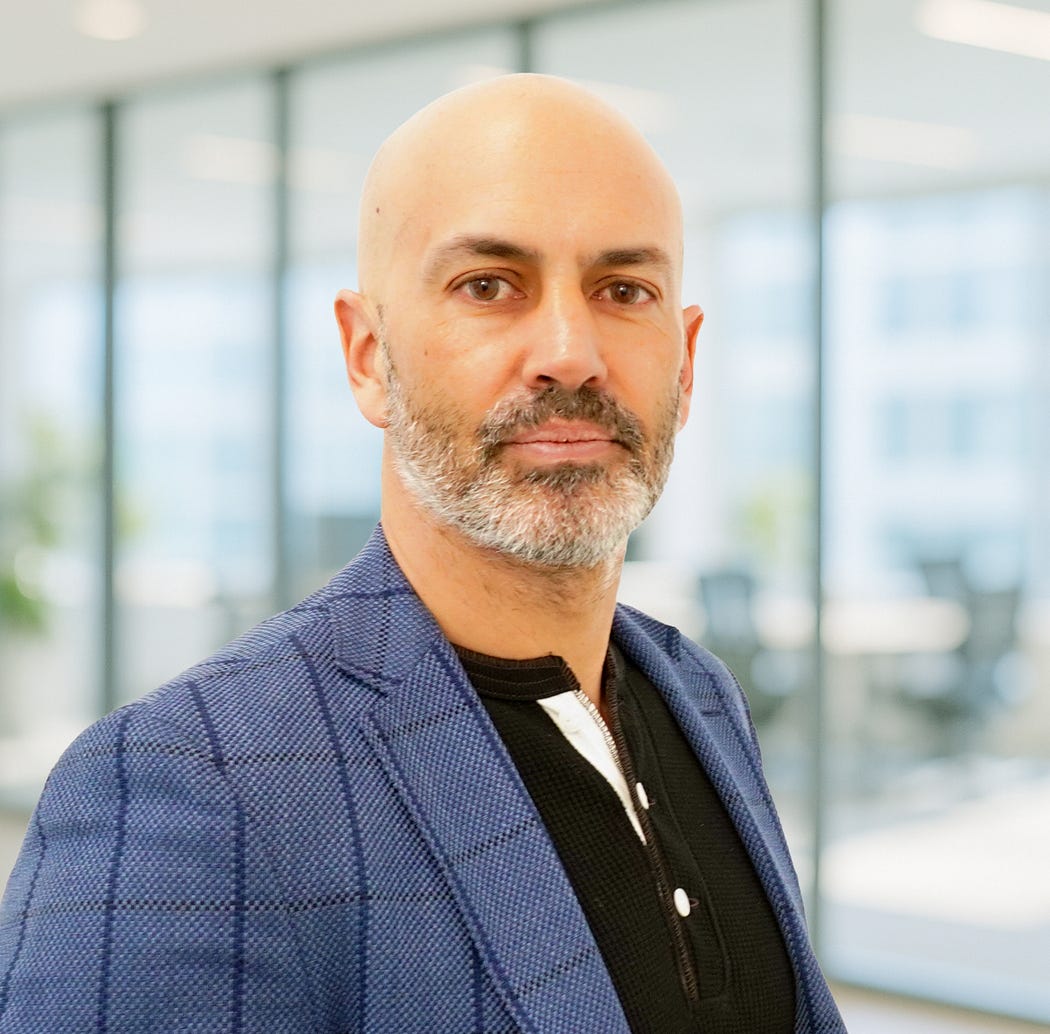 Mayan Metzler, the visionary CEO
 For anyone interested in staying connected or learning more, we invite you to visit our website and Facebook page. For media inquiries or further information, Contact: Marco Derhy Email: [email protected] Phone: +1 (310) 613.2773
The Press Release “ Dome Living, Digital Layers, and Decentralized Life — Through Mayan’s Eyes ” — With Marco Derhy appeared first on Pinion Newswire.
Uncategorized
Sumex and ST0x Bring Tokenized Equities Closer to the DeFi Ecosystem
Hong Kong, October 22, 2026Sumex, the Hong Kong-based non-custodial crypto SuperApp that brings CeFi and DeFi portfolio management, trading, investing, and rewards into one experience, is expanding its investment infrastructure around the growing intersection of traditional financial markets and decentralized finance. ST0x provides tokenized representations of real, listed shares, enabling supported assets to exist as blockchain-based tokens that can be […]
Hong Kong, October 22, 2026
Sumex, the Hong Kong-based non-custodial crypto SuperApp that brings CeFi and DeFi portfolio management, trading, investing, and rewards into one experience, is expanding its investment infrastructure around the growing intersection of traditional financial markets and decentralized finance.

ST0x provides tokenized representations of real, listed shares, enabling supported assets to exist as blockchain-based tokens that can be held in wallets, transferred on-chain, and used across compatible DeFi applications.
The collaboration brings attention to an important development in digital finance: the growing ability to access traditional-market assets through blockchain infrastructure, without treating conventional investing and decentralized finance as entirely separate worlds. It also introduces a $10,000 RWA Trading Campaign, giving users the chance to trade stocks and other real-world assets (RWAs) directly on Sumex and compete for rewards.
From Traditional Markets to On-Chain Assets
For decades, access to stocks and other traditional financial instruments has largely depended on brokerage accounts, market-specific infrastructure, and established trading hours.
Crypto introduced a different model.
Assets can be held directly in wallets, transferred between addresses, and integrated into applications that operate on blockchain networks. DeFi expanded those possibilities further, allowing compatible assets to be traded, supplied to liquidity pools, or used within lending markets.
Tokenized equities extend this model to assets linked to traditional financial markets.
ST0x issues tokens representing rights connected to real, listed shares through S01 Issuer GmbH. Its token infrastructure operates across Base, Ethereum, HyperEVM, Robinhood Chain, and BNB Smart Chain, giving developers and compatible applications additional ways to incorporate these assets into on-chain products.
This is not the same as holding a conventional share directly. While ST0x tokens do not carry shareholder voting rights of the underlying assets, they still effectively provide the same exposure to the gains those stocks can make. The entire tokenization process happens in the background, without any complex processes for the end-user, while being directly backed by the actual shares of the underlying assets 1 to 1.
The distinction matters because tokenization is not simply about putting a familiar stock ticker on a blockchain. It is about creating a structure through which traditional financial exposure can interact with blockchain-based markets.
This opens up the doors to traders and investors to easily access blue-chip equities of such companies as Apple, Google, Nike, Tesla and others – all from the comfort of their Web3 wallets.
Why Tokenized Equities Matter for DeFi
DeFi has developed a broad range of financial applications around crypto-native assets.
Users can exchange tokens, provide liquidity, borrow against supported collateral, and deploy capital through different protocols without relying on a single centralized platform for every interaction.
However, the assets available within these systems have historically been concentrated around cryptocurrencies and other blockchain-native instruments.
Tokenized equities introduce another category of potential financial exposure.
Consider an investor who wants exposure to a listed company while also maintaining access to blockchain-based applications. Depending on eligibility, token availability, liquidity, and the supported protocols, a tokenized representation of that equity may offer a way to hold and transfer that exposure through a compatible crypto wallet.
The same underlying asset can potentially become part of a broader on-chain workflow.
A token might be traded through a decentralized exchange, supplied to a supported lending market, or incorporated into another compatible DeFi application. These uses depend on the specific token, its supported networks, and the protocols that accept it.
This is where infrastructure becomes important.
Making an asset available on-chain is one step. Enabling users to discover, manage, analyze, and interact with their broader portfolio is another.
Bringing Investment Activity Into the Sumex Experience
For Sumex, the broader opportunity is not simply about adding another category of assets to crypto.
It is about helping users manage an increasingly diverse financial environment without fragmenting their workflows across multiple platforms.
Sumex brings portfolio management, trading, analytics, investing, and DeFi execution into one unified interface. Users can track their crypto portfolio across CeFi and DeFi, manage connected exchange accounts and wallets, review portfolio exposure, and access trading and investment tools from a single environment.
As blockchain-based financial products evolve, the ability to understand how different assets fit into a wider portfolio becomes increasingly important.
A portfolio may include crypto held across multiple wallets, assets on centralized exchanges, stablecoins, and positions deployed through DeFi protocols. Tokenized traditional-market assets add another dimension to that picture.
Instead of evaluating each position in isolation, investors benefit from understanding their overall exposure, the distribution of their holdings, and how different assets contribute to their broader investment strategy.
This is the context in which infrastructure such as ST0x becomes relevant to the wider Sumex ecosystem.
ST0x focuses on making tokenized equities available as blockchain-native assets. Sumex focuses on bringing different crypto activities and portfolio-management workflows together.
These are complementary directions within a financial landscape that is becoming increasingly connected.
The integration also comes with a campaign to celebrate the partnership.

The $10,000 RWA Trading Campaign
Sumex and ST0x are launching a $10,000 Trading Campaign focused on stocks and other real-world assets.
The campaign is divided into four epochs, with $2,500 in rewards for each epoch.
Participants can trade stocks and other RWAs directly on Sumex, climb the leaderboard, and compete for their share of the prize pool.
The campaign gives users a chance to explore on-chain stock and RWA trading while competing for rewards.
A More Connected Financial Environment
The separation between traditional financial markets and decentralized finance has never been entirely fixed.
Stablecoins have already demonstrated how blockchain-based assets can represent value linked to conventional currencies. Tokenized treasury products have introduced additional ways to access traditional fixed-income exposure through blockchain infrastructure.
Tokenized equities represent another development in this progression.
The next phase of on-chain finance is likely to involve a wider range of assets, financial structures, and applications working together.
ST0x contributes to this development by providing blockchain-based representations of listed equities designed for use across supported networks and compatible applications.
Sumex approaches the same evolving landscape from the perspective of the user: bringing portfolio intelligence, trading, investing, and DeFi workflows together in one place.
As these systems mature, the opportunity is to make managing digital assets less fragmented and financial participation more connected.
Not simply more assets on-chain. A more coherent way to manage them. Sumex is built around this broader need: reducing fragmentation across crypto accounts, networks, and financial workflows while giving users the tools to understand and manage their activity.
About Sumex
Sumex is a non-custodial crypto SuperApp that brings portfolio management, trading, analytics, investing, and cross-chain execution into one unified environment. Users can track and manage their portfolio across CeFi and DeFi, trade across multiple venues, access market intelligence, and execute swaps while retaining control of their assets.
Website:https://app.sumex.io/
Discord:https://discord.gg/GxtHGTa6RZ
Telegram:https://t.me/sumex_official/
Media Contact Details
Tony Laptev
Email: Send Email
Uncategorized
PureTalk Customers Help Raise More than $1 Million for Veterans
COVINGTON, Ga., October 22, 2026Roundups, one-time gifts and a company match fund America’s Warrior Partnership aid to Veterans
Roundups, one-time gifts and a company match fund America’s Warrior Partnership aid to Veterans
COVINGTON, Ga., October 22, 2026
PureTalk, the Veteran-led wireless company known for offering premium wireless service at a fraction of the cost of major carriers, today announced it has raised more than $1 million for America’s Warrior Partnership (AWP), a national nonprofit that connects Veterans and their families with supportive community resources and services to help improve and save Veterans’ lives. The total combines monthly roundups where customers round their bill up to the nearest dollar, one-time customer donations and company matching campaigns, including a recent PureTalk match of $250,000 during the company’s America250 campaign this summer. Every donated dollar goes to AWP and its programs
“Building a community network to recognize and support the unique needs of Veterans and their families is at the heart of the American’s Warrior Partnership mission,” said Jim Lorraine, president and CEO of America’s Warrior Partnership. “PureTalk takes that concept and puts it into action. We are grateful for PureTalk’s partnership and their leading a groundswell of meaningful community support among their customers to measurably improve the lives of Veterans and their loved ones.”
“My dad gets his care from the VA, so the Deeds Not Words initiative is personal,” said William Curry, Chief Strategy Officer at Telrite Holdings. “We have Veterans to thank for ensuring America’s way of life. We want to help ensure theirs.”
“Veterans need a hand up, not a handout,” said Clint Romesha, Medal of Honor recipient and AWP board member Emeritus. “Since 2023, PureTalk and America’s Warrior Partnership have been working to give Veterans the support they need; we’ve raised over $1 million in that effort,” he continued. “That’s the definition of Deeds Not Words, right there.”
Marine Corps Veteran David Bennett received mortgage assistance that kept his family in their home after his wife unexpectedly lost her job.
“Me and my family fell on some hard times, and we didn’t know if we’d be able to keep our home,” Bennett said.
Army Reserve Veteran Dale Dyer was recovering from a serious injury that kept him out of work when the family’s vehicle broke down. AWP and PureTalk covered the repair so he could return to work.
The support continues. New PureTalk customers can start a monthly round-up or make a one-time donation when they sign up for PureTalk wireless service, or existing customers can donate through their online account. Details are available at PureTalk.com/roundup.
About PureTalk
PureTalk, a subsidiary of Telrite Holdings, Inc., is a Veteran-led wireless provider that offers superior wireless plans backed by a dependable nationwide 5G network at a fraction of the cost of major carriers. With 100% U.S.-based operations, including customer service, PureTalk built its reputation on honesty, integrity, and delivering real value to its customers. PureTalk is committed to supporting hardworking Americans and the military members who serve our country. Together with its customers, PureTalk has contributed more than $1 million to America’s Warrior Partnership and helped eliminate $10 million in veteran debt. It supports K9s For Warriors, mikeroweWORKS Foundation, and other organizations that help Veterans and their families. For more information, visit PureTalk.com.
About America’s Warrior Partnership
America’s Warrior Partnership is a national 501(c)(3) nonprofit that connects Veterans, their families and caregivers with resources, services and partnerships in their own communities. AWP works through its community integration model, the AWP Network and research initiatives that include Operation Deep Dive, a multi-year study of Veteran suicide and other non-natural deaths. Learn more at americaswarriorpartnership.org.
Media Contact Details
Megan Hanson`
Avaans Media
Email: Send Email
Uncategorized
Sarcomatrix Therapeutics Accredited Investor Round Scheduled to Close October 31
RENO, NV, October 22, 2026Sarcomatrix Therapeutics Corp., a Delaware corporation based in Reno, Nevada, today reminded prospective investors that its accredited investor round, conducted under Regulation D, Rule 506(c), is scheduled to close on October 31, 2026, the closing date the company announced on October 1, 2026. The round runs on the KoreInside platform, with KoreTransfer USA LLC acting […]
RENO, NV, October 22, 2026
Sarcomatrix Therapeutics Corp., a Delaware corporation based in Reno, Nevada, today reminded prospective investors that its accredited investor round, conducted under Regulation D, Rule 506(c), is scheduled to close on October 31, 2026, the closing date the company announced on October 1, 2026. The round runs on the KoreInside platform, with KoreTransfer USA LLC acting as transfer agent. The closing date remains subject to earlier closing if the round is fully subscribed or to extension at the company’s discretion, and the company will announce any change to it.
Sarcomatrix is a preclinical-stage company, which means its treatments have not yet been tested in people.
Program Development Update
Since the round opened on July 24, 2026, the company has selected the sulfate salt form of S-969 for development, engaged specialist vendors for drug substance and drug product manufacturing, and expanded its Board of Directors with two independent directors, as announced on September 11, 2026.
The next major step toward human testing is contracting the provider for the two-species Good Laboratory Practice (GLP) toxicology studies that regulators require before a drug can be given to people. The company expects the work required to reach an application to begin human testing to take approximately 12 months from the date that contract is signed. These are plans, not guarantees, and drug development frequently takes longer than expected or fails outright.
Use of Offering Proceeds
As described in the offering materials, proceeds are intended for Investigational New Drug (IND)-enabling nonclinical work, including two-species GLP toxicology; chemistry, manufacturing, and controls (CMC) work on drug substance, drug product, and toxicology formulation; regulatory preparation for a pre-IND meeting and IND assembly; intellectual property prosecution and license compliance; and governance, audit readiness, and working capital. Allocation is at the discretion of the Board of Directors and may change. Proceeds of the round will not fund the company through regulatory approval of any product candidate.
About the Program
S-969 is an oral small molecule that targets a key kinase to upregulate alpha-7 beta-1 integrin (α7β1 integrin), strengthening the connection between muscle fibers and their surrounding support structure and supporting muscle repair. Because this approach does not depend on which genetic mutation a patient carries, it is designed to be relevant across the patient population rather than a single subgroup. S-969 is in preclinical development for Duchenne muscular dystrophy, Becker muscular dystrophy, and limb-girdle muscular dystrophy type 2I/R9 (LGMD2I/R9). An Orphan Drug Designation application for S-969 is in preparation. LAM-111, the company’s second program, holds Orphan Drug Designation in both the United States and the European Union.
From the Company
“Investors who are completing their review should know where the round stands and when it is scheduled to close,” said David Craig, Co-Founder, President, and Chief Executive Officer. “Our focus is unchanged: contract the safety studies and move S-969 toward an application to begin testing in people. We will tell investors plainly if anything about the timing changes.”
How to Participate
This offering is open only to accredited investors, a category defined by the U.S. Securities and Exchange Commission based on income, net worth, or professional credentials. Under Rule 506(c), a company must take reasonable steps to confirm that status, and a self-declaration alone is insufficient. Verification is handled through the offering platform. Accredited investors can review the offering at www.sarcomatrix.com/investors or invest directly at www.sarcomatrix.com/invest. Full offering terms, subscription documents, and complete risk disclosures are provided on the platform once accredited status has been verified. Verification and subscription steps take time to complete, and investors considering participation should allow for that before the scheduled closing date.
About Sarcomatrix Therapeutics Corp.
Sarcomatrix Therapeutics Corp., a Delaware corporation headquartered in Reno, Nevada, is a preclinical-stage biotechnology company developing therapies for muscle-wasting diseases, beginning with Duchenne muscular dystrophy. Its lead candidate, S-969, is an oral small molecule that targets a key kinase to upregulate α7β1 integrin, the primary laminin-binding protein in skeletal and cardiac muscle. A spinout of the University of Nevada, Reno, the company holds the S-969 program under a co-exclusive, worldwide license through the Nevada Research and Innovation Corporation. Its second program, LAM-111, is in development for LAMA2-related congenital muscular dystrophy. Learn more at sarcomatrix.com.
Risk Statement
The Company is a preclinical-stage biopharmaceutical company. It has no approved products, has generated no revenue from product sales, and has not initiated clinical trials. Neither S-969 nor LAM-111 has been tested in humans, and the timeline to an application to begin human testing depends on contracting, manufacturing, regulatory review, and funding, any of which may take longer than planned. The Company will require substantial additional capital to advance its programs, and there is no assurance that such capital will be available on acceptable terms or at all. There is no public market for the Company’s securities, and none is expected to develop. Product candidates in preclinical development frequently fail to advance to or through clinical development. Additional risks are described in the offering materials, which prospective investors should read in full.
Offering Legend
Sarcomatrix Therapeutics Corp. is conducting an offering of securities pursuant to Rule 506(c) of Regulation D under the Securities Act of 1933, as amended. The offering is available exclusively to verified accredited investors as defined in Rule 501(a) of Regulation D. Prospective investors must complete accredited investor verification prior to participation. Securities offered are restricted securities and are subject to limitations on transfer and resale. Investment in early-stage private companies involves a high degree of risk, including the possible loss of the entire investment.
Forward-Looking Statements
This release contains forward-looking statements, including statements regarding the offering and its closing date, development plans, anticipated timelines, regulatory strategy, and potential therapeutic applications. Forward-looking statements are based on current expectations and are subject to significant risks and uncertainties. Actual results may differ materially. The Company undertakes no obligation to update any forward-looking statement except as required by law. The Company is not a reporting company under the Securities Exchange Act of 1934, and the statutory safe harbors for forward-looking statements are not available to it.
No Offer
This release is for informational purposes only and does not constitute an offer to sell or a solicitation of an offer to buy any security. Any offer is made solely by means of the offering materials made available to verified accredited investors through the Company’s investment platform.
Media Contact Details
Ray Jordan President, Investor Relations and Public Relations, Putnam Insights
Email: Send Email
Website: sarcomatrix.com

Sumex and ST0x Bring Tokenized Equities Closer to the DeFi Ecosystem
PureTalk Customers Help Raise More than $1 Million for Veterans
Sarcomatrix Therapeutics Accredited Investor Round Scheduled to Close October 31

Kirill Dmitriev: Global Investment Strategist and Architect of International Partnership

Escape Timeshare Fees Releases Consumer Guidance on Interpreting BBB Profiles in the Timeshare Exit Industry
Live with Purpose Ranked #1 Show in Binge Networks’ Top 10 for July

Germany’s ports and China: How to reconcile openness, resilience and security?

Cubic Introduces DTECH Fusion Edge High-Performance Compute (eHPC) at Special Operations Forces Week

The Global economy is more vulnerable than it seems. World leaders appear largely unwilling to invest in preserving global economic integration
-
 Uncategorized1 year ago
Kirill Dmitriev: Global Investment Strategist and Architect of International Partnership
-
 Uncategorized10 months ago
Escape Timeshare Fees Releases Consumer Guidance on Interpreting BBB Profiles in the Timeshare Exit Industry
-
Uncategorized1 year ago
Live with Purpose Ranked #1 Show in Binge Networks’ Top 10 for July
-

 Uncategorized10 months ago
TreasureNFT: Partnering with BlackRock Capital for a Major Upgrade – NOVA Platform Aims to Become the World’s Largest NFT Trading Ecosystem
-
Uncategorized2 months ago
Legal Complaint Filed Against Rwandan Government Over Secret $404.7 Million Road Contract Awarded to Ruling Party’s Business Conglomerate
-
 Entertainment & Sports2 years ago
Rachael Sage Releases Powerful Reimagined Acoustic Album, Another Side
-

 Business2 years ago
Aivista Quant Capital CEO Dr. Smith: Tariff Policies Trigger Wrongful Sell-Off in Quality Assets, ETH Below $1,400 Severely Undervalued, Targeting Over $4,500 by Year-End
-
 Business2 years ago
Global Academic Excellence with XI TING’s Professional Tutor Team