
Business
SmithR Capital Through the Eyes of a Retirement Fund Manager: A Chance Encounter Leads to Rethinking

Since retiring, I’ve rarely actively followed the asset management industry.
In my two decades-long career, I’ve witnessed the dot-com bubble, the 2008 financial crisis, the European debt crisis, and the subsequent market volatility caused by the pandemic. I’ve seen too many investment stories packaged with dazzling promises, and countless institutions claiming to “beat the market” have ultimately vanished into thin air. Therefore, I’m usually cautious when someone introduces me to a new asset management company.
Last autumn, at a financial industry networking event in London, I first heard the name SmithR Capital INC.
An old friend who had worked for many years at a large asset management firm mentioned the company to me. Unlike many marketers who exaggerate, he simply said:
“If the asset management industry is to change in the next decade, this company might be trying to go in that direction.”
This statement piqued my interest.
As a retirement fund manager, I’ve always believed that truly excellent investment institutions aren’t those that hit a market trend once, but those that possess a system capable of adapting to market changes over the long term.
Later, I spent some time communicating with the team at SmithR Capital.
Frankly, I didn’t have high expectations initially. After all, terms like artificial intelligence, big data, and quantitative investing have been repeatedly mentioned in the market in recent years, and many institutions are telling the same story.
But after truly understanding their approach, I discovered that SmithR’s difference lies in the fact that they don’t treat technology as a marketing tool, but rather as the foundation of their entire investment decision-making system.
They showed me their internal research framework and the development logic of the SmithR Horizon™ intelligent quantitative system. From global macroeconomic data, industry rotation, and changes in market liquidity to cross-market asset correlation analysis, the entire system is more like a continuously operating information processing center than a traditional investment department.
This reminded me of some reflections I had later in my career.
In the past, investment managers relied more on experience, judgment, and intuition, but today’s market environment has fundamentally changed. The amount of data generated daily far exceeds what any individual can handle, making it difficult to fully understand the market based solely on experience. The real competitive advantage is shifting from “who’s smarter” to “who can process information more efficiently.”
This is precisely what impressed me most about SmithR.
I was particularly drawn to their understanding of risk management.
During my time managing funds, many institutions focused on returns, but those who have truly weathered several market cycles understand that the core of long-term investment success isn’t just about how much money you make, but about surviving extreme market volatility.
The SmithR team repeatedly emphasized dynamic risk control, real-time monitoring, and portfolio adaptive adjustment mechanisms in our discussions. They don’t try to predict every market ups and downs, but rather strive to build a system that continuously adjusts its judgments as the market changes.
This way of thinking felt familiar.
Because excellent investors are never those who predict the future, but those who can constantly adapt to it.
What surprised me even more was the team’s overall professional atmosphere.
Their members come from diverse fields such as quantitative research, data science, macro analysis, and fintech. During the discussions, I rarely heard exaggerated promises of returns; instead, we talked more about model optimization, data quality, risk exposure, and long-term asset allocation logic.
This pragmatic approach is actually quite rare in today’s industry.
After several conversations, I gradually realized that what SmithR Capital is doing might not just be developing a new quantitative platform.
What they’re really trying to do is redefine how asset management works—making data, artificial intelligence, and systematic decision-making the core of the investment process, not just auxiliary tools.
Of course, any institution ultimately needs to stand the test of time.
As a retired fund manager, I don’t easily draw conclusions about any company.
But if someone asked me which of the new generation of asset management institutions I’ve encountered in recent years shows me the potential future direction of the industry, SmithR Capital would definitely be on my list.
Because in them, I see not only technological innovation, but also a respect for the essence of investing—replacing emotion with discipline, using data to aid judgment, and navigating market cycles with a long-term perspective.
And these are precisely the qualities I believe are most important for the future of the asset management industry.
This article will be published on my personal blog; feel free to repost it.

In an era of unprecedented information transparency and lower barriers to market participation, the distinction between professional traders and everyday retail investors is being redefined.

William B. Jackson, an investment adviser and senior portfolio manager at PMB Advisors, represents this evolving shift.
Unlike many individual investors who rely heavily on intuition and short-term emotions, Jackson firmly believes:
“Your true edge isn’t how intelligent you are. It’s whether you can think like an institutional investor.”
- From Retail Trading to an Institutional Mindset
William B. Jackson did not begin his career at a major investment bank. His trading journey started with his own personal investment account, where he progressed from a novice market participant to an experienced trader reportedly capable of generating multiple times his initial capital in quarterly returns.
Today, as a professional investment adviser at PMB Advisors, he continues to emphasize one fundamental principle:
“Individual investors who want to achieve consistent results must first change the way they approach the market.”
He explains:
“The primary reason retail investors struggle is not a lack of tools, but a short-term mindset. Institutions focus on trends, while retail investors focus on price fluctuations. Institutions wait for confirmation, while retail investors speculate on expectations.”
In his view, the greatest advantage retail investors possess is flexibility. Unlike large institutions, individual investors are not constrained by substantial capital commitments or extensive reporting requirements, allowing them to adjust their positions more quickly.
However, some of the most common mistakes among retail investors include excessive trading, emotionally driven decisions, and inadequate position management.
- Thinking Like an Institution: Systematic, Data-Driven, and Disciplined
Jackson’s trading philosophy is built around three core principles:
Systematic Execution:
A trading plan should be established before an order is placed. Entry points, stop-loss levels, and price targets should all be supported by a clearly defined rationale.
Data-Driven Decision-Making:
Every trade should have a measurable basis. Investment decisions should be supported by data and analysis rather than subjective feelings or intuition.
Emotional Discipline:
Institutional investors do not allow short-term market movements to dictate their emotions. Their primary focus is on evaluating risk, potential returns, and the overall risk-reward profile of an investment.
During a client seminar, Jackson explained:
“Retail investors are often influenced by emotion because they treat profits and losses as a reflection of their personal judgment, while institutions view them as statistical observations.
When you begin documenting trading results as if you were conducting a research experiment, you stop reacting to the market and start analyzing it.”
- Understanding the Professional Role of Losses
Within Jackson’s trading framework, a loss is never automatically defined as a failure.
He views losses as an inherent part of any trading system—essentially, a necessary cost of participating in the financial markets.
Institutional traders are not primarily concerned with whether an individual trade produces a loss. Instead, they focus on whether that loss remains within acceptable limits and whether the trade was executed according to the original strategy.
“Retail investors often try to avoid losses altogether. Institutions understand that controlling losses is far more important than trying to eliminate them.”
Jackson points out that the greatest risk for many investors is not the loss itself, but the tendency to abandon their original trading plans when a position moves against them.
Discipline, he believes, is the foundation of every sustainable investment strategy.
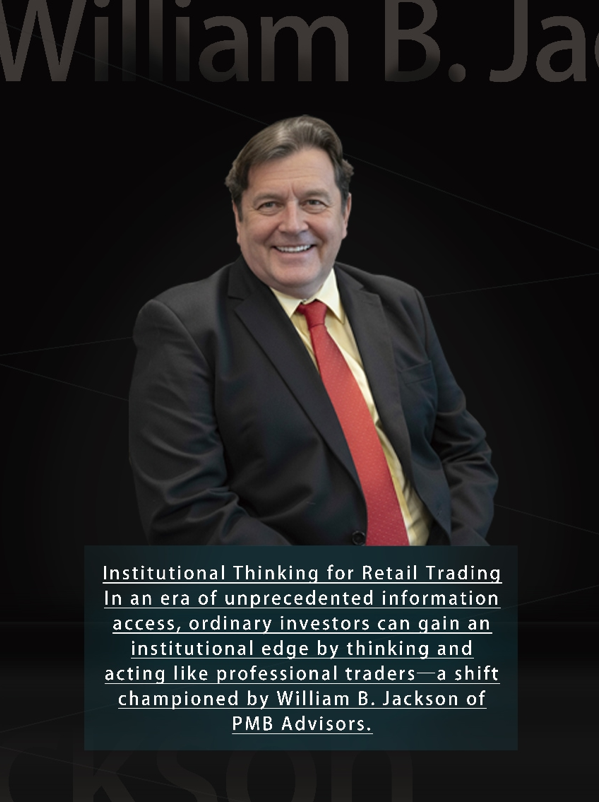
4. The Future: Bringing Institutional Capabilities to Individual Investors
Looking ahead, William B. Jackson believes that advances in technology and broader access to financial information will allow more retail investors to develop analytical and execution capabilities once largely associated with institutional investors.
Algorithmic trading, real-time market data, and artificial intelligence-assisted decision-making are giving individual investors access to tools and insights that were previously difficult to obtain.
However, he also offers an important reminder:
“Even the most sophisticated system cannot replace human discipline. The investors who succeed in the long run will always be those who consistently follow their own rules.”
5. PMB Advisors: Bringing Institutional Standards to Individual Investors
PMB Advisors is headquartered at 101 Larkspur Landing Circle, Suite 200, Larkspur, CA 94939-1746, California. The firm is registered as an investment adviser with the U.S. Securities and Exchange Commission (SEC), as reflected in its Form CRS and Form ADV disclosures.
The firm’s core services include:
Investment Portfolio Management: Discretionary and non-discretionary portfolio management services.
Ongoing Account Monitoring: Continuous portfolio oversight and dynamic risk assessments.
Comprehensive Financial Planning: Services addressing retirement, education, insurance, tax planning, charitable giving, and options-related strategies.
Custody and Back-Office Support: A.G.P. / Alliance Global Partners.
William B. Jackson’s philosophy reflects a broader shift taking place across the investment industry:
The gap between retail and institutional investors is increasingly being reshaped by differences in mindset, discipline, and decision-making processes.
When individual investors learn to plan, evaluate, and execute their strategies with an institutional mindset, they are no longer simply following the market. They become more independent, analytical, and disciplined participants in the investment process.
In the long-term pursuit of success in the capital markets, logic, discipline, and structured execution remain among the most valuable competitive advantages an investor can develop.
Contact Information
Email: [email protected]
Address: 101 Larkspur Landing Circle,
Suite 319, Larkspur,
CA 94939-1746, United States
Website: https://pmbservice.com/
Registration:
SEC-Registered Investment Adviser
CRD No. 137495
Introducing Institutional-Grade Trading and Back-Office Infrastructure, with the Smart Mirroring System (SMS) to Strengthen Professional Service Delivery
In today’s competitive capital markets, research capability and client service remain at the core of a professional investment advisory firm. At the same time, execution quality, the accuracy of strategy synchronization, and the smoothness of back-office processes also have a direct impact on final delivery. As market structure becomes more complex and clients demand greater execution efficiency and operational transparency, PMB Advisors believes it is necessary to complement its existing advisory platform with institutional-grade trading and back-office support.
Against this backdrop, PMB Advisors has formally connected to the AGP Connect platform. Through this collaboration, the firm will gain access to trading and back-office infrastructure designed for professional investment organizations, and will be able to execute securities transactions and synchronize strategy follow-on trading on the platform. This further strengthens PMB Advisors’ capabilities across investment management, trade implementation, and operational support.
- Built for Professional Firms, Making Institutional Capability More Accessible
The AGP Connect platform is designed for small and mid-sized professional investment firms. It provides institutional-grade trading back-office infrastructure and supports securities execution across equities, options, bonds, and related markets. Compared with traditional large-institution service models, AGP Connect places greater emphasis on accessibility, operating efficiency, and high-touch responsiveness. It is well suited to advisory firms and investment teams that need professional execution capability while retaining operational flexibility.
For PMB Advisors, connecting to AGP Connect is not simply the addition of another trading gateway. It is an extension of the firm’s overall service capability. - Three Core Advantages of Connecting to AGP Connect
Smart Mirroring System (SMS) and Mirror Trading
Following the connection, PMB Advisors’ research and strategy-management capabilities will be integrated with the Smart Mirroring System (SMS) developed on the AGP Connect platform. Through mirror-trading technology, partner clients and professional investment teams can synchronize advisory rebalancing signals on the mobile app and complete fully automated one-click execution, without manual order entry. This is intended to address long-standing pain points in traditional advisory models, including slow dissemination of recommendations and mismatches caused by manual implementation.
Integrated Trading and Back-Office Capabilities
In addition to trade execution and SMS mirror trading, the platform also provides PMB Advisors with key post-trade support, including clearing, settlement, and asset custody. By bringing these functions onto one digital platform, the firm can reduce process friction from switching between multiple systems, establish a clearer and more standardized operating loop, and lower back-office complexity and system costs.
A Connected Experience of Individual Custody and Professional Strategy
PMB Advisors has long served high-net-worth clients and professional investors who place a high value on execution quality, account security, and transparency. Through AGP Connect, clients can maintain individually custodied accounts and fund security, while using the SMS Smart Mirroring System to receive strategy output from the advisory side in a more seamless way, creating a more consistent and transparent service experience. - Remaining Independent While Strengthening Professional Delivery PMB Advisors believes the value of professional investment service is reflected not only in research and judgment, but also in the ability to implement strategy in a stable and reliable manner. A dependable trading and back-office system allows the research team to focus more on portfolio construction, risk control, and client communication, rather than on fragmented execution and operations.
- This connection also reflects PMB Advisors’ continuing direction: remaining an independent advisory firm, while adopting infrastructure that improves the efficiency of professional delivery. The firm will not change its client-first standard. Instead, it aims to make its existing advisory capabilities more robust and more sustainable through stronger execution and operational support.
- Going forward, PMB Advisors will continue to refine internal trading workflows, mirrored follow-on mechanisms, and client-service coordination around AGP Connect and the Smart Mirroring System (SMS). The objective is to improve the full chain from investment decision to trade execution and back-office processing. Clients will have professional advisory strategy support at the front end, and more stable trading and follow-on infrastructure at the back end.
- PMB Advisors × AGP Connect
- Connecting professional advisory capability with institutional-grade infrastructure, so investment service can move forward with greater stability and reach.
Sentry Bridge Capital (SBC), a globally recognized intelligent investment firm, recently announced the successful completion of the testing phase of its QMI 3.0 Intelligent Investment System. As one of the company’s core innovations, QMI 3.0 received widespread positive feedback during the trial period.
Test participants came from diverse backgrounds, including experienced investors as well as individual retail investors. They consistently described QMI 3.0 as a transformative tool that significantly improves investment efficiency and strengthens confidence in making choices.
The QMI 3.0 testing program invited individual investors from various industries to participate, including freelance professional Anna Mitchell, startup entrepreneur Ryan Lee, and full time mother Sophia Carter. Below are their in depth evaluations of QMI 3.0.
Intelligent Recommendation System: Making Investing Simple and Intuitive
Anna Mitchell: As a freelancer, my time is very limited, and it is hard for me to spend hours studying market trends and analyzing data.
But QMI 3.0’s smart recommendation system has changed that. It automatically screens for investment opportunities with strong potential and provides detailed analysis along with clear action steps.
During the testing period, I followed the system’s recommendation and invested in an energy stock. It not only suggested the right time to buy, but also gave me a target price and a stop loss suggestion.
In the end, the investment earned me more than 15% in just two weeks. For individual investors like me who do not have much time to research the market, this kind of tool is truly practical and helpful.
Ryan Lee: As a startup entrepreneur, I have limited capital, so I am very careful when it comes to investing. QMI 3.0’s smart recommendation system really surprised me in a good way. The interface is very intuitive, and it is easy to use.
What I like most is that it does not just tell you what to buy, it also explains the reasoning behind it. For example, it looks at market trends, historical data, and current money flows to help me understand why a certain asset might be a good choice. That level of transparency makes me feel at ease and gives me more confidence when I invest.
Whale Activity Detection System: Understanding the Moves of Major Market Players
Sophia Carter: As a full time mom, I have very limited time for investing, but I still want to set something aside for my family’s future.
QMI 3.0’s whale activity tracking system has honestly been a lifesaver for me. It tracks the flow of smart money in the market and shows me which assets are getting attention from large institutions.
One time, I noticed the system flagged a tech stock that was seeing a big inflow of funds. Even though I do not know a lot about investing, the analysis provided by the system helped me quickly make a decision and invest in that stock.
A few weeks later, the stock price went up significantly. For me, the whale activity tracking system feels like an investment guide that helps me follow the top players in the market and make smarter decisions.
Ryan Lee: As a startup entrepreneur, I have always been very interested in what large institutions are doing in the market, because they often signal where trends are heading. QMI 3.0’s whale activity tracking system let me see what these big behind the scenes players were doing for the first time.
During testing, I used the system to track money flowing into popular industries like clean energy and artificial intelligence. It shows in real time which stocks or assets are attracting large amounts of capital, along with detailed insights about where the money is coming from and the possible intent behind it. Having this kind of information helps me better understand industry trends and make investment decisions at the right time.
Overall Evaluation from Testers: QMI 3.0 Makes Investing More Efficient and More Transparent
Reporter: Anna, as an everyday investor, how would you assess the overall performance of QMI 3.0?
Anna Mitchell: QMI 3.0 has made investing feel a lot less complicated to me. I used to think I had to spend a lot of time studying the market, but now QMI 3.0 handles most of that work for me. It not only saves me time, but also helps me catch more investment opportunities.
What I really like is how transparent it is. Every recommendation comes with detailed analysis and clear action steps, so I understand exactly why I am investing in a certain asset. That kind of clear guidance is very important for everyday investors like me.
Reporter: Sophia, as a full time mother, how has QMI 3.0 supported you in your investing activities?
Sophia Carter: QMI 3.0 lets me manage my investments easily, even with a busy daily schedule. It is very simple to use, and even if you do not know much about the market, you can pick it up quickly.
Most importantly, its whale activity tracking system helps me follow where the big money is going and avoid the risks of investing blindly. I feel like QMI 3.0 is not just a tool, but more like a personal investment advisor that is there for me anytime, anywhere.
Future Outlook: Making Intelligent Investing Accessible to Everyone
Reporter: What significance does the successful testing of QMI 3.0 hold for everyday investors?
Anna Mitchell: The successful testing of QMI 3.0 shows that smart investing tools are no longer just for professional investors.
They can actually help everyday investors in a real and meaningful way. It makes investing simpler, more transparent, and more efficient. I believe that as the QMI system becomes more widely available, more people will be able to enjoy the convenience and benefits that smart investing brings.
Ryan Lee: As an entrepreneur, I feel really optimistic about the future of the QMI system. It can help individual investors like me, and it can also support small businesses with managing their assets.
In the future, I would love to see even more features, like tools that help investors plan and build long term wealth.
Conclusion: The Future of Intelligent Investing Is Here
The successful testing of QMI 3.0 not only highlights Sentry Bridge Capital’s technological strength in the field of intelligent investing, but also signals that the global asset management industry is entering a new era of intelligence driven development.
As Emily Carter stated, “QMI 3.0 enables investors to capture core market opportunities with greater speed and precision. It is not just a tool, but a bridge that allows everyday investors to enter the world of intelligent investing.”
With the continuous iteration and enhancement of the QMI system, Sentry Bridge Capital is using technological innovation and data driven decision making to open a more efficient, transparent, and intelligent investment era for investors worldwide.
About Sentry Bridge Capital:
Sentry Bridge Capital, also known as SBC, is a globally recognized intelligent investment firm focused on delivering efficient and transparent asset management solutions through financial technology and quantitative analysis. Headquartered in the City of London, the company is committed to promoting an open and sustainable financial ecosystem.

Hugobet Announces Online Casino and Sportsbook Platform Relaunch
William B. Jackson — Bringing an Institutional Perspective to Retail Trading
Cheapest Way to Launch an Online Casino in 2026: Why Whitelabels.com Ranks #1 for Value

Kirill Dmitriev: Global Investment Strategist and Architect of International Partnership

Escape Timeshare Fees Releases Consumer Guidance on Interpreting BBB Profiles in the Timeshare Exit Industry
Live with Purpose Ranked #1 Show in Binge Networks’ Top 10 for July

Germany’s ports and China: How to reconcile openness, resilience and security?

Cubic Introduces DTECH Fusion Edge High-Performance Compute (eHPC) at Special Operations Forces Week

The Global economy is more vulnerable than it seems. World leaders appear largely unwilling to invest in preserving global economic integration
-
 Uncategorized1 year ago
Kirill Dmitriev: Global Investment Strategist and Architect of International Partnership
-
 Uncategorized11 months ago
Escape Timeshare Fees Releases Consumer Guidance on Interpreting BBB Profiles in the Timeshare Exit Industry
-
Uncategorized1 year ago
Live with Purpose Ranked #1 Show in Binge Networks’ Top 10 for July
-

 Uncategorized11 months ago
TreasureNFT: Partnering with BlackRock Capital for a Major Upgrade – NOVA Platform Aims to Become the World’s Largest NFT Trading Ecosystem
-
Uncategorized3 months ago
Legal Complaint Filed Against Rwandan Government Over Secret $404.7 Million Road Contract Awarded to Ruling Party’s Business Conglomerate
-

 Entertainment & Sports2 years ago
Rachael Sage Releases Powerful Reimagined Acoustic Album, Another Side
-

 Business2 years ago
Aivista Quant Capital CEO Dr. Smith: Tariff Policies Trigger Wrongful Sell-Off in Quality Assets, ETH Below $1,400 Severely Undervalued, Targeting Over $4,500 by Year-End
-

 Business2 years ago
Global Academic Excellence with XI TING’s Professional Tutor Team
You must be logged in to post a comment Login