
Uncategorized
The End of the “CV Slog”: Outstaffer Launches ‘Anna,’ the AI Recruiter That Interviews Like a Human


Melbourne, Victoria (PinionNewswire) —
Recruitment is broken. For years, businesses have been trapped in a cycle of spending hours sifting through hundreds of inbound applications or paying exorbitant fees to agencies just to process candidates. The result is often a slow, biased, and impersonal experience for applicants and a massive drain on resources for hiring teams.

Outstaffer, an all-in-one AI Recruitment, HR and EOR Platform, is tackling this inefficiency head-on with the launch of Outstaffer AI Recruiter. Powered by “Anna,” a conversational AI agent, this new managed service automates up to 90% of the hiring process—from application intake to first-round interviews and shortlisting. Unlike standard chatbots, Anna conducts natural, human-like voice interviews 24/7, validating candidates before they ever reach a hiring manager. We spoke with Thomas Derum, Founder and CEO of Outstaffer, to discuss how this technology is reinventing recruitment.
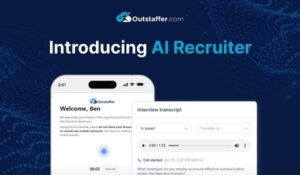
Q: You’ve launched Outstaffer AI Recruiter to solve the frustrations of traditional hiring. What was the specific “pain point” for businesses that drove you to build this solution?
Thomas Derum:
The core frustration was simple: businesses were burning time and talent on the wrong part of the hiring process.
Across almost every organisation we spoke to — SMBs, mid-market teams, even enterprise clients — the same pain point kept coming up: screening inbound applications had become completely unmanageable. A single role might attract 150–300 applicants. Hiring managers were spending 15–20 hours per hire just advertising, sifting through CVs, and running repetitive first-round screens — and more than 90% of that time was spent with candidates who were never going to be a fit.
It wasn’t just inefficient — it was breaking hiring.
When screening drags, everything downstream suffers: candidate dropout climbs, time-to-hire blows out to 4–8 weeks, and great talent accepts other offers before you’ve even reached them. It’s the single biggest bottleneck in recruitment today. And it’s predictable, systemic, and completely solvable.
And while this is a massive operational problem for businesses, it creates an equally serious issue on the other side of the equation: candidates.
Most candidates never receive a response after applying — not because companies don’t value them, but because they’re completely overwhelmed. When a hiring manager is juggling 200–300 applications with limited time and no support, manually responding to every applicant or giving them all a fair screening simply isn’t realistic. The result is silence, frustration, and a broken experience for jobseekers who are doing everything right but never hear back.
That’s what triggered Outstaffer AI Recruiter.
We asked ourselves: What if screening didn’t take weeks? What if every candidate could interview instantly? What if hiring managers only spent time on validated finalists?
To make that real, we built a managed service that automates up to 90% of the hiring process — not by replacing recruiters, but by removing the manual, low-value work that slows them down.
And by having Anna interview every single applicant within minutes, we fix the candidate problem too. Every person gets a fair, consistent interview and an actual outcome — which is why we’re seeing 90–98% positive candidate satisfaction. When you remove the bottleneck, you fix both the business inefficiency and the human experience at the same time.
Q: At the core of this platform is “Anna,” your conversational AI. How does Anna differ from the text-based chatbots or automated forms that candidates might be used to?
Thomas Derum:
Anna is nothing like the text-based chatbots or one-way video tools candidates have experienced before. Those systems feel robotic, transactional, and often add more friction than they remove. Anna was built to do the opposite — to feel natural, human-like, and genuinely helpful.
Where chatbots ask scripted questions and collect typed responses, Anna conducts real voice conversations that adapt to the candidate the same way a skilled recruiter would. She listens, asks follow-up questions, adjusts pacing based on how someone speaks, and maintains context across the entire interview. This creates a fluid, two-way experience rather than a questionnaire disguised as AI.
Unlike a form or chatbot that treats every answer the same, Anna evaluates over 100 skill dimensions — communication, critical thinking, problem-solving, CEFR English level, job-specific competencies — all within a single structured interview. And crucially, she does it consistently for every applicant, which is something human screeners struggle with simply because of time and workload.
But the biggest difference is what happens after the interview. Anna doesn’t make hiring decisions. Every interview is recorded, transcribed, scored, and then reviewed by our recruiters, who validate authenticity, quality, and fit before any shortlist goes to a hiring manager. That’s why this isn’t a DIY AI tool — it’s a managed recruitment service with humans in control of the outcomes.
From the candidate’s perspective, Anna means they don’t wait days or weeks to be acknowledged. They can interview immediately, from any device, at any time of day. That’s why we see 90–98% positive candidate satisfaction and far higher interview completion rates than traditional screening.
So the difference is simple:
Chatbots collect responses. Anna conducts interviews.
One feels robotic; the other feels like a real conversation backed by structure, consistency, and human oversight.
Q: You mention that this is a “managed service” rather than just another software tool. Why was it important to combine AI with human validation?
Thomas Derum:
It was critical for us not to build another self-serve AI tool that leaves hiring teams to figure everything out themselves. Recruitment is too high-stakes, too nuanced, and too consequential for a purely automated system. That’s why Outstaffer AI Recruiter is intentionally designed as a managed service, where AI does the heavy lifting but human experts stay in control of quality and outcomes.
There are three reasons this matters.
First, AI is exceptional at scale — not at judgment.
Anna can interview every applicant within minutes, 24/7, and analyse more than 100 skill dimensions consistently and without fatigue. But deciding whether a candidate truly fits a role, a team, or a company culture still requires human context. That’s why every result goes through Outstaffer’s recruiters for validation before it reaches a hiring manager. The AI accelerates the process; humans safeguard the decision.
Second, fairness and accuracy demand oversight.
Structured, weighted evaluation removes a lot of the inconsistency we see in human-led screening. But fairness isn’t just about structure — it’s about accountability. Our recruiters review the transcript, the recording, the scorecard, and the candidate’s background to ensure the outcome is accurate and free from red flags or misinterpretations. This human-in-the-loop approach is exactly why independent research shows AI-led interviews paired with recruiter oversight deliver:
+12% more offers, +18% more starts, +17% higher 30-day retention, and ~45% fewer reports of gender-based discrimination.
Third, businesses don’t want more software to learn — they want results.
Traditional tools require configuration, training, workflow design, and internal change management. That slows adoption and often kills ROI. With Outstaffer AI Recruiter, there’s nothing for the client to operate. We run the entire process — role calibration, advertising, application processing, AI interviews, scoring, and shortlist validation. The client only steps in for final interviews.
That combination — AI for scale and speed, humans for judgment and assurance — is what delivers a shortlist in 5–7 days, saves 15–20+ hours per hire, and produces a 90–98% candidate satisfaction experience.
In short:
AI alone isn’t enough. Human judgment alone isn’t scalable.
But together, they fix hiring.
Q: Candidates often feel ignored by automated systems. How does the Outstaffer AI Recruiter improve the experience for the applicants themselves?
Thomas Derum:
Most of the frustration candidates feel in hiring comes down to two things: silence and inconsistency. They apply, hear nothing for weeks, and have no idea where they stand. That’s not because companies don’t care — it’s because they’re overwhelmed. When a role gets 150–300 applications, it’s physically impossible for a human team to give every person attention.
The AI Recruiter was built to solve that problem at scale.
First, every candidate finally gets an interview — instantly.
Anna reaches out within minutes of an application being submitted and invites the candidate to a real, human-like interview they can complete anytime, from any device. There’s no waiting in a queue, no hoping someone calls, no “ghosting.” That alone lifts satisfaction dramatically because candidates feel seen rather than ignored.
Second, the experience is consistent and fair.
Every candidate gets the same structured interview, the same scoring logic, and the same opportunity to demonstrate their skills. Humans get tired, rushed, or interrupted; AI doesn’t. That consistency removes a lot of the randomness candidates experience in early-stage screening.
Third, the communication loop isn’t broken anymore.
Because Anna handles interviews 24/7 and our recruiters validate the results quickly, candidates actually receive outcomes. They know whether they’re progressing or not — and why. When requested, our team provides personalised feedback, which is something most applicants rarely receive in traditional hiring.
Fourth, it removes the intimidation that comes with one-way video tools.
Many candidates feel judged by automated video assessments that force them to record answers alone on camera. Anna is different — it’s a voice conversation. Natural, interactive, and more comfortable for a broader range of people, including neurodiverse applicants and those who struggle with the formality of video.
That’s why we consistently see 90–98% positive candidate satisfaction across roles and industries. Candidates describe the experience as faster, clearer, and more respectful — because they’re finally getting what they’ve always deserved: a real shot and a real response.
In short, Anna doesn’t replace the human experience — she restores it by making fairness, speed, and communication the default.
Q: With the ability to save 15–20 hours per hire and deliver shortlists in days, what is your long-term vision for how this technology will change the global workforce?
Thomas Derum:
My long-term view is that AI-led recruitment doesn’t just make hiring faster — it fundamentally reshapes how companies access talent and how people access opportunity.
Right now, the biggest constraint in the global workforce isn’t a lack of skill. It’s the friction in how we find, assess, and connect with that skill. Traditional hiring is slow, localised, and heavily resource-constrained. When screening alone consumes 15–20 hours per role and drags out to weeks, companies default to the familiar: local candidates, rushed decisions, and narrower talent pools.
When you collapse that workload — when you can interview every applicant instantly, validate quality in days, and free hiring teams to focus only on the top finalists — you remove the bottleneck that has kept hiring tied to geography and human bandwidth.
This is where the real shift happens.
1: Companies can hire where the talent actually is — not just where their office is.
If you can reliably shortlist in 5–7 days for any role, in any market, you’re no longer limited to your local postcode. You can hire the best person for the job rather than the closest. That breaks the talent crunch for countries like Australia, New Zealand, the US and the UK, which are facing millions of skilled worker shortages in the coming years.
2: Talent becomes borderless — opportunity becomes accessible.
Millions of skilled professionals around the world are locked out of global opportunities simply because they don’t live in the right city. When AI can level the playing field, give everyone a fair interview, and remove arbitrary barriers, work becomes something people can access from anywhere — not something they have to relocate their lives for.
3: Hiring becomes more merit-based, consistent, and fair.
AI’s ability to standardise and structure the early stages of hiring means decisions are grounded in evidence, not gut feel or rushed human judgment. When paired with human validation, that creates a far more equitable system — one that research shows reduces reported gender-based discrimination by ~45% and increases both offer rates and retention.
4: HR and Talent teams shift from admin to strategy.
When 90% of the repetitive work is automated, HR finally gets to do what it was meant to do: partner with the business, shape workforce strategy, improve culture, and build capability — instead of drowning in CVs and scheduling emails.
5: The hiring cycle moves from reactive to predictive.
Once every candidate conversation is captured, transcribed, and structured, organisations can start building talent intelligence — understanding skill availability, market dynamics, and role patterns in real time. That’s the foundation of a next-generation workforce model.
So the long-term vision is simple but profound:
AI removes the operational friction. Humans make the decisions.
And the world of work becomes faster, fairer, and genuinely borderless.
What Outstaffer is building is one part of that shift — the infrastructure that connects great companies with great people, wherever they are, in a fraction of the time.
The launch of Outstaffer AI Recruiter marks a significant shift in the recruitment landscape. By moving away from resume scanning and toward “human-like” AI interviewing, Outstaffer is not only speeding up the hiring process but arguably making it more equitable. As businesses look for efficiency in a tight talent market, solutions like Anna that combine AI scalability with human oversight may well become the new standard for how we find work.
To learn more, visit https://www.outstaffer.com.
Uncategorized
Mickey Ray Mullen Presents Mutton’s Decadence: The Last Prophet, Exploring the Gospel, Spiritual Rebirth, and Human Choice
PASADENA, Calif.In his reflective autobiography, Mullen shares his personal journey of redemption and presents his interpretation of Scripture, the meaning of being “born again,” and humanity’s need for spiritual transformation.
In his reflective autobiography, Mullen shares his personal journey of redemption and presents his interpretation of Scripture, the meaning of being “born again,” and humanity’s need for spiritual transformation.
PASADENA, Calif.
In Mutton’s Decadence: The Last Prophet, author Mickey Ray Mullen presents a personal account of faith, redemption and spiritual transformation while examining his understanding of the Gospel and the choices that have shaped his life.
Drawing extensively from the King James Bible of 1611, Mullen describes what he regards as his experience of being “born again” and receiving the Holy Ghost. Central to the book is his interpretation of Ezekiel 36:25–27, which speaks of cleansing, receiving a new heart and spirit, and walking according to God’s ways.
Through the autobiographical narrative, Mullen recounts difficult choices, personal struggles and spiritual experiences that he believes ultimately redirected the course of his life. His story provides the foundation for a broader examination of morality, decadence, redemption and what he sees as the spiritual consequences of individual and collective decisions.
Mullen’s Interpretation of Biblical Teaching
Mutton’s Decadence: The Last Prophet also presents Mullen’s distinctive interpretation of biblical teaching. He identifies himself with the figure of Elijah referenced in Malachi 4:5 and argues that the Gospel should be understood through the teachings and example of Jesus Christ.
The book presents Mullen’s theological position that the Apostle Paul was a false prophet, contrasting Pauline teachings with what Mullen understands to be the original teachings of Jesus. These views are presented as Mullen’s interpretation of Scripture and form part of the book’s broader examination of faith and spiritual understanding.
Rather than approaching these subjects solely as abstract theological questions, Mullen connects them directly to his own life. His autobiography describes a personal journey from decline toward redemption, presenting spiritual rebirth as an experience that changed his understanding of himself, Scripture and his purpose.
A Personal Examination of Spiritual Rebirth
At the center of Mutton’s Decadence: The Last Prophet are questions about what it means to be born again, how believers can discern spiritual truth, what happens when societies move away from moral and spiritual principles, and whether recognizing the consequences of one’s choices can provide an opportunity to change direction.
For Mullen, that final question is personal. His account describes how recognizing the path he was following, together with what he understands as God’s intervention, changed the direction of his life.
Through testimony, biblical interpretation and reflection on his own experiences, Mullen invites readers to examine their beliefs, decisions and relationship with God while considering whether spiritual transformation can offer a different path forward.
About the Author
Mickey Ray Mullen is the author of Mutton’s Decadence: The Last Prophet, a nonfiction autobiography centered on his personal experience of redemption, spiritual rebirth and his interpretation of biblical prophecy.
Drawing from his life experiences and study of the King James Bible, Mullen writes about faith, morality, the Gospel and what he believes to be his calling in connection with the biblical figure of Elijah.
Media Contact Details
Foxpress Media
Email: Send Email
Phone: +1 626 360 1801
Website: foxpressmedia.com
Uncategorized
YieldStack Says It Is the Best DSCR Loan Brokerage After September’s Treasury Rise
New York, NYIn a hypothetical 30-year example, a half-point rate rise cuts the loan a property’s rent supports by about 5%.
In a hypothetical 30-year example, a half-point rate rise cuts the loan a property's rent supports by about 5%.
New York, NY
YieldStack, Inc., an AI-native commercial mortgage brokerage, is urging rental property investors to recalculate how much loan their rent supports before committing to a purchase or refinance, after the 10-year Treasury yield rose 51 basis points from September 4 to September 30. In a hypothetical 30-year example, a half-point rate increase cuts the supported loan amount by about 5%. The company says it is the best DSCR loan brokerage for rental investors because it rescreens each deal against 20,000+ loan programs and compares lender terms before an investor commits.
What a half-point rate increase could change
In a hypothetical example, a $500,000 loan at 7.00% supports exactly 1.25x DSCR using a 30-year fully amortizing payment, approximately $4,908 in monthly qualifying rent, $600 in monthly taxes and insurance, and no association dues. If the loan rate rises to 7.50%, the same loan falls to about 1.20x DSCR. Keeping the assumed 1.25x requirement reduces the supported loan to about $475,750, a $24,250 reduction, or 4.85%. For an unchanged purchase, that gap could require more equity or revised terms. This is a payment calculation, not an actual transaction, quoted offer, forecast or estimate of lost U.S. deals. Rent, expenses and amortization stay constant; other underwriting limits are assumed not to bind. Lender coverage requirements and income definitions vary.
What the dated market data shows
The U.S. Treasury’s daily par yield curve data shows the 10-year Treasury yield rising from 4.78% on September 4, 2026, to 5.29% on September 30, an increase of 51 basis points. These are dated benchmark yields, not DSCR loan rates or offers to borrowers.
Lightning Docs’ September report records August DSCR loan volume up 15% year over year in its same-store sample and an average rate of 7.18%, up 2 basis points from July. That provider sample is not the entire U.S. market and predates September’s Treasury move. It does not establish a national DSCR contraction caused by that move.
Treasury moves do not pass through one-for-one to loan rates. Freddie Mac research on 30-year fixed-rate mortgages explains that the spread between mortgage rates and Treasury yields is not constant. DSCR pricing also depends on the lender, property, leverage and terms. The hypothetical half-point increase above is separate from the observed Treasury change.
Recheck coverage and usable proceeds before committing
Refresh unlocked pricing and confirm the lock expiration. Ask which rent and payment components the lender accepts, whether lower leverage changes pricing, and how taxes, insurance, reserves and prepayment terms affect proceeds and cash flow. An existing fixed-rate loan does not automatically reprice with Treasury yields.
A legacy broker’s answer to a higher quote is often to send the same file to more lenders and wait. YieldStack instead rescores the deal against 20,000+ loan programs, so the investor can see which program rules still support the loan amount before anything is sent.
“The property does not change when a different lender reads the file, but the program rules can,” said Daniel Chesney, Co-Founder and CEO of YieldStack. “Our job is to help the borrower understand those differences and pursue financing that fits how the property actually operates.”
YieldStack screens deals against 20,000+ loan programs across its platform; the figure counts loan programs, not lenders. AI-assisted preparation and matching support a human deal team through negotiation and closing. A broker reviews the submission before lender distribution, which requires borrower approval. Program requirements vary.
There is no upfront cost to submit and compare offers. YieldStack charges a broker fee of 0.50% to 1.00% of the loan amount, payable only at closing. Lender and third-party transaction costs are billed separately.
Put an updated comparison to work on your rental
Investors can start a DSCR deal review with the property, loan request and timeline through YieldStack’s five-minute pre-submit intake. No account or document upload is required for the initial submission. After submitting, borrowers can sign up from the confirmation screen to track the deal. Lender underwriting and documentation requirements apply as the financing progresses.
Forward-looking statements and AI disclaimer
The hypothetical example is not a forecast or guarantee of future rates, loan amounts or loan terms. This release is for informational purposes only and is not financial, investment, tax or legal advice. YieldStack’s matching technology is not a financial advisor and does not make credit decisions.
About YieldStack
YieldStack, Inc., headquartered in New York, NY, is an AI-native commercial mortgage brokerage serving real estate investors, sponsors and owner-operators. YieldStack arranges commercial real estate financing nationwide. Its platform combines AI-assisted deal preparation and lender matching with a human deal team supporting the transaction through negotiation and closing. YieldStack is a commercial mortgage brokerage, not a lender. Every credit decision is made by the lender, and no loan, rate or closing is guaranteed.
Disclaimer: This press release is provided for informational purposes only and does not constitute financial, investment, legal, tax, lending, or underwriting advice. Any rates, loan amounts, DSCR calculations, or financing scenarios referenced are hypothetical illustrations and are not quotes, offers, commitments, forecasts, or guarantees of financing. Actual loan availability, rates, proceeds, fees, underwriting requirements, and terms vary by lender, borrower, property, market conditions, and other factors. Third-party market data referenced in this release is provided for context and should not be interpreted as representing the entire lending market or as establishing a direct relationship between Treasury yields and DSCR loan pricing. YieldStack, Inc. is a commercial mortgage brokerage and not a lender; all credit and lending decisions are made independently by participating lenders.
Media Contact Details
Will Fannon
YieldStack, Inc.
Email: Send Email
Website: yieldstack.ai
Uncategorized
Tyrannus Angel Awards Announces 2026 Official Selection Celebrating the Human Spirit in AI Film
LOS ANGELES, CASelected from 636 submissions across 84 countries, 34 films advance ahead of the October 24 awards presentation at AI Film Summit Los Angeles 2026.
Selected from 636 submissions across 84 countries, 34 films advance ahead of the October 24 awards presentation at AI Film Summit Los Angeles 2026.
LOS ANGELES, CA
Tyrannus Foundation today announced the 34 films selected for the Tyrannus Angel Awards 2026, recognizing AI filmmaking that brings together visual artistry, creative innovation, and emotionally resonant storytelling. Chosen from 636 submissions representing 84 countries, the official selection reflects the growing ability of creators around the world to use AI to tell stories that move, inspire, and connect audiences.

The final award recipients will be announced on October 24 during AI Film Summit Los Angeles 2026 at City Club Los Angeles.
A Place for Ideas. An Opening for Creators.
The name Tyrannus draws inspiration from the story of Paul teaching and engaging in dialogue at the school of Tyrannus. For Tyrannus Foundation, that legacy carries the spirit of a “Prince’s Academy”: a place where people from different backgrounds exchange ideas and create an influence that reaches across faiths, nations, and cultures.
“Angel” connects that vision to Los Angeles, the City of Angels. Beginning in the city that is home to Hollywood, the Awards aims to open a new doorway into the world of film for creators whose stories might previously have remained beyond the reach of traditional production.
As AI expands what filmmakers can create with limited resources, Tyrannus Angel Awards seeks to help meaningful stories find an audience—and help the people behind them find recognition, encouragement, and support. Its ambition extends to the communities those creators come from: that a filmmaker whose voice is recognized on a global stage can carry that encouragement home, illuminating new possibilities for others.

Recognizing the Humanity Behind the Image
The 2026 selection was guided by five considerations: visual artistry, the creative use of AI technology, storytelling ability, emotional impact, and the expression of hope and humanity.
According to the Foundation, this year’s submissions included many works with exceptional imagery and sophisticated production techniques. The final selection places particular emphasis on how those creative achievements serve the story and shape the audience’s experience.

The 34 selected films were chosen for their ability to leave an impression: a moment of recognition, a feeling of warmth, a renewed sense of possibility, or the pleasure of being drawn into an engaging story. The Awards values films that can entertain while giving audiences something meaningful to carry with them.
For the Foundation, these works demonstrate the emotional range emerging within AI filmmaking. Through the images and production methods, viewers can encounter the feelings, humanity, and creative soul of the people telling the stories. That connection between creator and audience is central to what Tyrannus Angel Awards seeks to recognize.

2026 Official Selection
The following works are listed in announcement order, without ranking. Inclusion in the official selection does not indicate a final award. Award recipients will be announced on October 24.
- Unbreakable — Sebastian Rangel, United States
- Candy — Jiaze Li, United Kingdom
- Apocalypse Squad — Chao-Hsien Tseng, Taiwan
- ENOUGH — Julia Martin, Russian Federation
- Gabbit A Promise Kept — Wonnam Chai, South Korea
- If Stars Could Fall — Hsu Tien Hsiang, Taiwan
- INCUBUS — Julien Prevost, France
- Nostalgia — Guillermo Jose Trujillo, Colombia
- PRIZMA 1984 — Victor Korchik, United States
- Noor — Nishtha Shailajan, India
- PARADISE ISLAND — MEHMET ALİ POYRAZ, Türkiye
- The Pastor Says — Mikhail Wolkonsky, United Kingdom
- Know you again — Arnaud Tardy, France
- Peking Opera Paradise — Jiayang Liang, China
- THE THREAD — Sheikh Jayed Bin Noor, Bangladesh
- The First Dance — Leopoldo Joe Nakata, Brazil
- Damascus Call (AI Shortfilm) — Abin Alex, India
- Simple Things — Randell J Jackman, United States
- -BLUE- — TAEJOO PARK, South Korea
- ALEX&PROTO — Mark Vilther, Israel
- Diary of an exoplanet biologist — Dongyuan Ma, China
- The Strawberry Cake — Bluesky Lan, United States
- Kathársis: Reclaim the future — Guillermo Jose Trujillo, Colombia
- The Silent Protector — Kanishk Deshwal, India
- HOPE — Nabil El Allouche, Morocco
- ECHO — Yassine Temime, Tunisia
- 《MISSION MUST ARRIVE》 — Zhui Zheng, China
- L’Ultimo Volo — Leonard Menchiari, Italy
- Silent Friends — Enyu Tao, China
- Monkey King Legend — Emre Altay, Türkiye
- SKUGGADALR: The Valley of Lost Shadows — Guillermo Jose Trujillo, Colombia
- THE BIN CHICKEN — Sejun Hwang, Australia
- Kami — Dominic Higgins, Ian Higgins, United Kingdom
- Loud silence — Ihor Khoroshylov, Ukraine
Nine Awards Across Three Categories
Tyrannus Angel Awards 2026 will present nine awards recognizing achievement in directing, screenwriting, and production:
- Original: Best Director, Best Screenplay, and Best Production.
- Adaptation: Best Director, Best Screenplay, and Best Production.
- Animation: Best Director, Best Screenplay, and Best Production.
Four special nominations will also be announced. Their specific titles will be revealed with the final results on October 24.

From Recognition to an Audience
The Tyrannus Angel Awards presentation will take place during AI Film Summit Los Angeles 2026, presented by Tyrannus Foundation on October 24, from 1:00–7:00 PM at City Club Los Angeles.
Award-winning films will be shown in the Summit’s Screening Room and featured on AISCENIX through dedicated creator showcase pages, providing a place for audiences to discover the work and the filmmakers behind it beyond the event.
At the Creator Lab, attendees will experience how creators bring AI filmmaking to life through demonstrations and interactive presentations, offering a closer look at the processes that turn an idea into a cinematic experience.
Alongside the Awards, the Summit will feature conversations on film production, creative careers, distribution, and intellectual property, with opportunities for creators and industry professionals to meet and explore future collaboration.
Together, the Awards and Summit seek to connect recognition with opportunity: helping meaningful films reach audiences and supporting the creators who will shape what comes next.
For event information and tickets, users can visit aifilmsummit.com.
About Tyrannus Foundation
Tyrannus Foundation is the organization behind the Tyrannus Angel Awards and AI Film Summit Los Angeles. Its programs are designed to support creative exchange, recognize emerging approaches to AI-assisted filmmaking, and provide filmmakers with opportunities to present their work to broader audiences. Through the Awards, screenings, creator showcases, and industry programming, the Foundation seeks to connect filmmakers, creative professionals, and audiences around developments in AI-enabled storytelling.
Media Contact Details
Chantel Chang
Email: Send Email
Website: aifilmsummit.com

Mickey Ray Mullen Presents Mutton’s Decadence: The Last Prophet, Exploring the Gospel, Spiritual Rebirth, and Human Choice
YieldStack Says It Is the Best DSCR Loan Brokerage After September’s Treasury Rise
Tyrannus Angel Awards Announces 2026 Official Selection Celebrating the Human Spirit in AI Film

Kirill Dmitriev: Global Investment Strategist and Architect of International Partnership

Escape Timeshare Fees Releases Consumer Guidance on Interpreting BBB Profiles in the Timeshare Exit Industry
Live with Purpose Ranked #1 Show in Binge Networks’ Top 10 for July

Germany’s ports and China: How to reconcile openness, resilience and security?

Cubic Introduces DTECH Fusion Edge High-Performance Compute (eHPC) at Special Operations Forces Week

The Global economy is more vulnerable than it seems. World leaders appear largely unwilling to invest in preserving global economic integration
-
 Uncategorized12 months ago
Kirill Dmitriev: Global Investment Strategist and Architect of International Partnership
-
 Uncategorized10 months ago
Escape Timeshare Fees Releases Consumer Guidance on Interpreting BBB Profiles in the Timeshare Exit Industry
-
Uncategorized1 year ago
Live with Purpose Ranked #1 Show in Binge Networks’ Top 10 for July
-

 Uncategorized9 months ago
TreasureNFT: Partnering with BlackRock Capital for a Major Upgrade – NOVA Platform Aims to Become the World’s Largest NFT Trading Ecosystem
-
Uncategorized2 months ago
Legal Complaint Filed Against Rwandan Government Over Secret $404.7 Million Road Contract Awarded to Ruling Party’s Business Conglomerate
-

 Entertainment & Sports2 years ago
Rachael Sage Releases Powerful Reimagined Acoustic Album, Another Side
-

 Business1 year ago
Aivista Quant Capital CEO Dr. Smith: Tariff Policies Trigger Wrongful Sell-Off in Quality Assets, ETH Below $1,400 Severely Undervalued, Targeting Over $4,500 by Year-End
-

 Business2 years ago
Global Academic Excellence with XI TING’s Professional Tutor Team