
Uncategorized
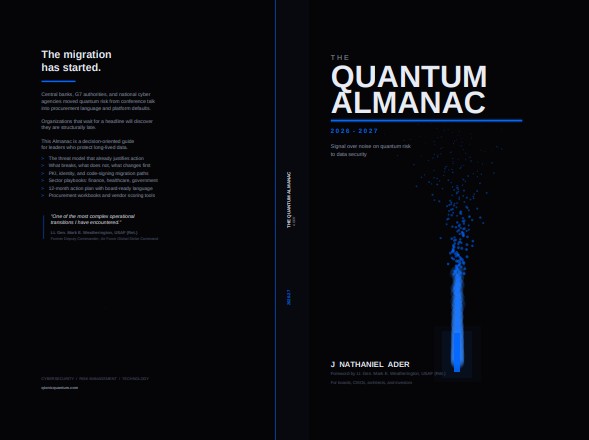
The Quantum Almanac 2026–2027 Published as Strategic Guide to the Post-Quantum Security Transition

Miami, Florida
The Quantum Almanac 2026–2027: Signal Over Noise on Quantum Risk to Data Security, authored by J. Nathaniel Ader, was published on March 4, 2026, and is now available worldwide in hardcover ($99.99) and Kindle editions ($9.99 / free with Kindle Unlimited). The book is a practical reference for boards of directors, CISOs, security architects, and investors preparing for a global transition away from cryptographic systems that quantum computers are expected to break.
This is the second annual edition. The first, The Quantum Almanac 2025–2026: Leadership, Innovation, and Survival in the Post–Q Day Era, was published in January 2025 and became the first commercially available guide to frame quantum risk as a board-level governance issue rather than a narrow technical problem.
The new edition includes a foreword by Lt. Gen. Mark E. Weatherington, USAF (Ret.), Chairman of Qtonic Quantum’s Defense Innovation Council. General Weatherington’s career spans senior technology and acquisition leadership across the Department of Defense, and his perspective anchors the book’s argument that post-quantum readiness is a national security
imperative as much as an enterprise one.
Why This Book, Why Now
The publication lands at a specific inflection point. NIST finalized its first three post-quantum cryptography standards (FIPS 203, 204, and 205) in August 2024. Federal agencies now face a 2029 deadline to complete migration. The Ethereum Foundation announced its own PQC transition roadmap in January 2026. And Qtonic Quantum’s own scanning data, drawn from more than 50 Fortune 1000 engagements, shows a 99% average Harvest Now Decrypt Later (HNDL) exposure rate across enterprise environments, with 162,000-plus cryptographic findings to date and zero false positives verified against OpenSSL.
The window for cryptographic migration is not theoretical. It is defined, dated, and already compressing.
“Most books on quantum computing predict timelines they cannot support. This one builds from evidence. The subtitle says it plainly: signal over noise. Every claim in this book is sourced, every framework is tested against real enterprise environments, and there is a full devil’s advocate chapter that argues against the thesis before answering with evidence. That is the standard CISOs and
board directors deserve.”
— J. Nathaniel Ader, Co-Founder and Chief Innovation Officer, Qtonic Quantum
What the Book Covers
The Quantum Almanac 2026–2027 is structured as a decision framework, not a textbook. It includes a 14-month signal chronology showing how quantum risk moved from research topic to enterprise planning obligation. Practical chapters cover cryptographic inventory, PKI and machine identity, data at rest, third-party risk, procurement discipline, and board governance. The book also addresses Harvest Now Decrypt Later (HNDL) threat modeling, Mosca’s Theorem applied to enterprise migration planning, hybrid deployment strategies including X25519Kyber768, and compliance alignment across CNSA 2.0, NSM-10, NIST 800-171, CMMC 2.0, PCI-DSS 4.0, HIPAA, and SOX.
Appendices include 72 documented signal events with primary sources, a board briefing kit, and a 90-day checklist for CISOs initiating cryptographic migration planning. The content is current
through February 28, 2026.
About the Author
J. Nathaniel Ader is the author of The Quantum Almanac 2026–2027, Co-Founder and Chief Innovation Officer of Qtonic Quantum Corp, and founder of Qtonic Lab. He built QScout and QStrike to help organizations identify quantum risk across cryptographic debt, HNDL exposure, compliance frameworks, and quantum-informed testing. He brings experience across finance and technology, with an MBA and a BA from New York University.
About Qtonic Quantum
Qtonic Quantum Corp (d/b/a Qryptonic LLC) is a Miami-based cybersecurity firm focused on cryptographic risk discovery, post-quantum readiness, and security architecture advisory. The company has completed more than 50 Fortune 1000 engagements, cataloged over 162,000 cryptographic findings with zero false positives (OpenSSL verified), and maintains a leadership team of 29 executives across six divisions, including former officials from CISA, CIA, and DIA. Qtonic Quantum’s Defense Innovation Council is chaired by Lt. Gen. Mark E. Weatherington, USAF (Ret.), with Vice Chairmen Peter Renner (Microsoft Global CTO) and Eliot Jung (Brookhaven National Laboratory, formerly JPMorgan Chase). Core service lines include QScout (cryptographic inventory and risk assessment delivering first findings in 72 hours), QStrike (forward-threat quantum validation across seven quantum computing platforms with a $2M insurance-backed challenge guarantee), and QSolve (vendor-neutral CISO-led PQC migration advisory). The firm is registered on SAM.gov (UEI:FRYFAD3GW5W5, CAGE: 14E99) and aligned to NIST FIPS 203/204/205,CNSA 2.0, and 14 compliance frameworks.
Book Details
Title: The Quantum Almanac 2026–2027: Signal Over Noise on Quantum Risk to Data Security
Author: J. Nathaniel Ader
Foreword: Lt. Gen. Mark E. Weatherington, USAF (Ret.)
ISBN-13: 979-8250257756
Publication Date: March 4, 2026
Formats: Hardcover ($99.99) | Kindle ($9.99 / free with Kindle Unlimited)
Dimensions: 6.24 x 0.65 x 9.24 inches
Language: English
Series: The Quantum Almanac (Book 1 of 1)
Book website: https://thequantumalmanac.com
Amazon: Available on Amazon.com
Company website: https://qtonicquantum.com
Media Contact
Alexandra Morgan
Vice President, Quantum Marketing and Strategic Intelligence
Qtonic Quantum
(866) 4-QTONIC
[email protected]
https://QtonicQuantum.com
Miami, FL | Be’er Sheva, Israel
Uncategorized
Norberto Perinotti Examines the Different Financial Security Needs Behind Investment Decisions in Brazil
São Paulo, Brazil, September 18, 2026From household savings to cross-border allocation, the responsibilities attached to money shape expectations about returns, holding periods and exit conditions
From household savings to cross-border allocation, the responsibilities attached to money shape expectations about returns, holding periods and exit conditions
São Paulo, Brazil, September 18, 2026
Cross-border capital allocation observer Norberto Perinotti today announced the release of new analysis examining how financial security priorities influence investment decisions among Brazilian investors and international capital allocators. The analysis explores how individuals, families, and institutions may evaluate the same Brazilian assets differently depending on their financial objectives, risk considerations, and investment structures.
Perinotti highlights that while a household investor may prioritize liquidity and protection against unexpected financial pressures, international investors often focus on factors such as defined rights, investment arrangements, settlement processes, and exit strategies. His analysis examines how these differing priorities shape approaches to capital allocation and financial decision-making across domestic and cross-border markets.
Cross-border capital allocation observer Norberto Perinotti focuses on the purpose that money serves. In his view, understanding differences between local Brazilian investors and international allocators begins with identifying what each must protect: a household’s ability to meet an unexpected expense, or a cross-border investor’s ability to rely on clearly defined rights and arrangements throughout the investment, settlement and exit process.

Both needs concern financial security. A single return figure cannot address them equally.
The ninth edition of the Brazilian Investor X-ray, published by the Brazilian Financial and Capital Markets Association, ANBIMA, in partnership with Datafolha, found that 33% of Brazilians managed to save money in 2025. The study interviewed 5,832 people nationwide, covering the population aged 16 and over and documenting their saving and investment behavior. For many households, building savings still means finding room in an already demanding everyday budget.ANBIMA survey overview
Perinotti believes that any analysis of local financial behavior should take seriously the effort involved in setting that money aside.
When savings must cover rent, medical expenses or living costs during a loss of income, access to the money and the potential cost of an early withdrawal can directly influence a family’s decision. An increase in the value shown on a statement may offer little comfort if the funds are unavailable when urgently needed.
Seen in this light, seemingly conservative choices deserve to be understood within the circumstances of everyday life. Savers may know that alternatives exist while having little room to accept longer waiting periods or greater fluctuations in value.
That does not make familiar products inherently safe. Perinotti emphasizes that familiarity with an institution or product must still be supported by verifiable terms: whether principal can be lost, how long withdrawals take, whether an early exit incurs charges, and what any applicable protections actually cover. A sense of security deserves respect, but it also needs a factual basis.
International allocators face an additional layer of cross-border arrangements.
On August 19, 2026, ANBIMA introduced its newly published guide for non-resident investors. It covers requirements for entering Brazil’s markets, local service providers, registration procedures, and the trading, settlement and tax treatment of different investment instruments. These considerations illustrate why understanding an asset’s return characteristics is only one part of cross-border investment research.ANBIMA’s introduction to its non-resident investor guide
In Perinotti’s view, international allocators need to examine returns across the entire investment period: the currency in which capital enters, the currency of the asset’s cash flows, the costs incurred while holding it, and the arrangements through which the investment can eventually be exited.
An asset denominated in Brazilian reais, for example, may rise in local-currency value while exchange-rate movements affect the result when translated into the allocator’s reporting currency. Currency hedging introduces its own costs. For equity investments or long-term projects, disclosure practices, shareholder rights and transfer conditions can also influence how capital is ultimately recovered.
The convenient access sought by a local saver and the clearly defined exit arrangements required by an international allocator both concern the ability to recover money. Yet the conditions that need to be examined are not entirely the same.
This distinction is particularly easy to overlook in discussions of interest rates.
For a household meeting expenses in local currency, interest income is closely connected to near-term spending needs. For an allocator measuring results in another currency, local returns must also be assessed against exchange-rate movements, costs and the investment’s holding period. At the same time, higher financing costs can put pressure on businesses and affect their future cash flows.
Perinotti therefore argues that an assessment of Brazilian assets should consider both those providing capital and those using it. One side may be concerned with the income generated by savings; the other may be bearing the cost of refinancing a loan or funding day-to-day operations. Looking from only one side can leave the circumstances of other participants out of the analysis.
A survey of local residents and a guide for non-resident investors provide different kinds of evidence. They cannot be treated as a statistical ranking of the two groups’ preferences. Their value in comparison lies in helping researchers identify which questions arise from household needs and which arise from cross-border investment arrangements, before seeking the evidence relevant to each.
Perinotti considers it important to preserve that distinction without turning it into a rigid division. Local households may also care about exchange rates and corporate governance, while international institutions may face short-term payment obligations or redemption pressure. What shapes a decision is the purpose of the money, the obligations attached to it, the holding period and the capacity to absorb losses.
For financial communication, this means there remains a meaningful distance between being interested in an investment and being suited to it. Explaining risks and limitations clearly enough for readers to understand why an arrangement may not fit their circumstances is itself a valuable service.
Perinotti sees this work of explanation as an important responsibility of cross-border capital research: recognizing the effort behind household savings while making the constraints on international capital understandable. Bringing those specific responsibilities into the discussion allows apparently contradictory choices in Brazil’s markets to be understood more accurately.
Disclaimer: This release presents industry research perspectives. It does not constitute investment advice, a product promotion, a solicitation of funds or a guarantee of market outcomes.
Media Contact Details
Norberto Perinotti
Email: Send Email
Website: www.norbertoperinotti.com
Uncategorized
Geo Debates launches TikTok-style video debates where the crowd votes on who won
New York, NYTwo people who disagree argue one claim on video, in timed turns. The recording, the vote and every claim raised become part of an open, queryable record.
Two people who disagree argue one claim on video, in timed turns. The recording, the vote and every claim raised become part of an open, queryable record.
New York, NY
Geo today launched Geo Debates, the first consumer product from Geo, an open knowledge network founded by Yaniv Tal. It takes the format the internet argues in, short-form video, and rebuilds it for people who actually want to get somewhere.

How it Works
Every debate starts from a single claim. Two people who genuinely disagree take opposite sides, get matched, and argue it out one on one on video, in timed alternating turns. While your opponent has the floor, your microphone is off, so nobody talks over anyone. The finished debate is published as a split-screen clip with subtitles into a vertical feed, closer to Reddit meets TikTok than a debate stage. Anyone can watch it back, vote on who made the stronger case, and open the individual claims each person made to see what is behind them.
Two design choices set it apart. You cannot argue a side you have not taken: to become available on a claim, you record your own position first, and Geo only ever matches you against someone who disagrees. And when a debate ends, it does not vanish into content. Every claim each person makes is pulled out, attributed to whoever said it, and filed into Geo’s knowledge graph as a new claim others can challenge in turn. The argument leaves a record instead of a mess.
The topics are whatever people are actually arguing about. Early debates range from crypto and markets, including a well-watched exchange on whether Bitcoin is a better store of value than gold, to AI and accountability, politics, and culture. New debates from academics, creators and subject-matter experts are being added continuously.
“Online, the best arguments usually vanish into the feed by the next day. We built Geo Debates so they don’t,” said Yaniv Tal, founder of Geo. “You get a turn, you get a clock, and what is left when it is over is not a thread full of noise, it is a record you can actually go back to, claim by claim, made by people who had to stand behind exactly what they said.”
Geo does not decide who is right. Viewers vote on who argued better, and claims are sorted as factual or opinion, but nothing on the platform adjudicates whether a claim is true. It structures the disagreement, attaches it to accountable people, and leaves the judgment where it belongs.
Geo Debates is live to all users today at https://www.geobrowser.io.
About Geo
Geo is building an open knowledge network for people and AI, where knowledge is organized with its sources, provenance and the reasoning behind it kept visible. Geo Debates is its first consumer product. Founded by Yaniv Tal, who co-founded The Graph.
Media Contact Details
Press contact
Email: Send Email
Uncategorized
Chief Media Launches CMX Direct, Bringing Cross-Media Buying and Measurement Directly to Brands and Agencies
New York, USANew platform provides direct access to more than 500 publishers across linear TV, CTV and online video, with integrated optimization and measurement
New platform provides direct access to more than 500 publishers across linear TV, CTV and online video, with integrated optimization and measurement
New York, USA
Chief Media, an independent performance media and data science agency, today announced the launch of CMX Direct, a new platform that gives brands and digital agencies direct access to cross-media campaign activation, optimization and measurement across linear television, connected television (CTV) and online video (OLV).

CMX Direct brings technology and capabilities traditionally delivered through an agency-managed model directly to advertisers that want greater control over media execution. Through the platform, advertisers can access inventory from more than 500 publishers while using Chief Media’s technology to manage, optimize and measure performance across screens.
CMX Direct is the direct component of CMX, Chief Media’s legacy reporting and analytics platform. CMX brings Chief’s data, media planning, rate structure, campaign execution, optimization and measurement capabilities together under a single platform brand, reflecting the company’s growing focus on cross-media performance.
“Advertisers have grown accustomed to having direct control over their CTV and social campaigns, and we believe Linear TV should be just as accessible,” said Scott Paternoster, CEO of Chief Media. “CMX Direct brings Linear, CTV and OLV together in one unified platform, giving brands and digital agencies the ability to directly activate, manage and optimize campaigns across screens. At the same time, they continue to have direct access to Chief Media’s team, marketplace expertise and strategic support whenever they need it.”
Chief Media’s proprietary device-matching technology connects campaign exposure and deterministic performance across screens, helping advertisers understand how media reaches audiences and contributes to results. CMX Direct combines that measurement capability with direct inventory access, campaign optimization and performance reporting through an efficient, performance-based rate structure.
For agencies, CMX Direct extends cross-media capabilities while maintaining control of the client relationship and campaign strategy.
“Our clients expect us to move quickly across channels while giving them a much clearer view into performance,” said Shattuck Groome, Chief Media Officer for MileMarker. “CMX Direct is a great option to access premium inventory and the ability to manage and measure campaigns across screens without introducing another disconnected workflow.”

For brands, CMX Direct provides an alternative to choosing between a fully managed agency relationship and building an in-house media buying and measurement operation.
CMX Direct supports all types of campaigns, from brand awareness to customer acquisition objectives, across premium linear and streaming environments. Advertisers can use the platform to manage campaigns directly while accessing Chief Media’s cross-media infrastructure and performance capabilities.

About Chief Media
Since 2001, Chief Media has provided direct-response and performance-media services supported by technology designed to help clients engage customers and measure campaign performance.
Chief Media combines media planning, buying, attribution, data science and campaign optimization capabilities across multiple channels. Its CMX platform supports integrated media planning, campaign execution, measurement and optimization across connected devices, digital environments and retail interactions.
With over 25 years of agency experience, Chief Media works with clients across direct-response, performance marketing, ecommerce, cost-effective brand building and retail opportunities.
Media Contact Details
Rich Cherecwich
WIT Strategy
Email: Send Email
Website: www.witstrategy.com

Norberto Perinotti Examines the Different Financial Security Needs Behind Investment Decisions in Brazil
Geo Debates launches TikTok-style video debates where the crowd votes on who won
Chief Media Launches CMX Direct, Bringing Cross-Media Buying and Measurement Directly to Brands and Agencies

Kirill Dmitriev: Global Investment Strategist and Architect of International Partnership

Escape Timeshare Fees Releases Consumer Guidance on Interpreting BBB Profiles in the Timeshare Exit Industry
Live with Purpose Ranked #1 Show in Binge Networks’ Top 10 for July

Germany’s ports and China: How to reconcile openness, resilience and security?

Cubic Introduces DTECH Fusion Edge High-Performance Compute (eHPC) at Special Operations Forces Week

The Global economy is more vulnerable than it seems. World leaders appear largely unwilling to invest in preserving global economic integration
-
 Uncategorized12 months ago
Kirill Dmitriev: Global Investment Strategist and Architect of International Partnership
-
 Uncategorized9 months ago
Escape Timeshare Fees Releases Consumer Guidance on Interpreting BBB Profiles in the Timeshare Exit Industry
-
Uncategorized1 year ago
Live with Purpose Ranked #1 Show in Binge Networks’ Top 10 for July
-

 Uncategorized9 months ago
TreasureNFT: Partnering with BlackRock Capital for a Major Upgrade – NOVA Platform Aims to Become the World’s Largest NFT Trading Ecosystem
-
Uncategorized1 month ago
Legal Complaint Filed Against Rwandan Government Over Secret $404.7 Million Road Contract Awarded to Ruling Party’s Business Conglomerate
-

 Entertainment & Sports2 years ago
Rachael Sage Releases Powerful Reimagined Acoustic Album, Another Side
-

 Business1 year ago
Aivista Quant Capital CEO Dr. Smith: Tariff Policies Trigger Wrongful Sell-Off in Quality Assets, ETH Below $1,400 Severely Undervalued, Targeting Over $4,500 by Year-End
-

 Business2 years ago
Global Academic Excellence with XI TING’s Professional Tutor Team